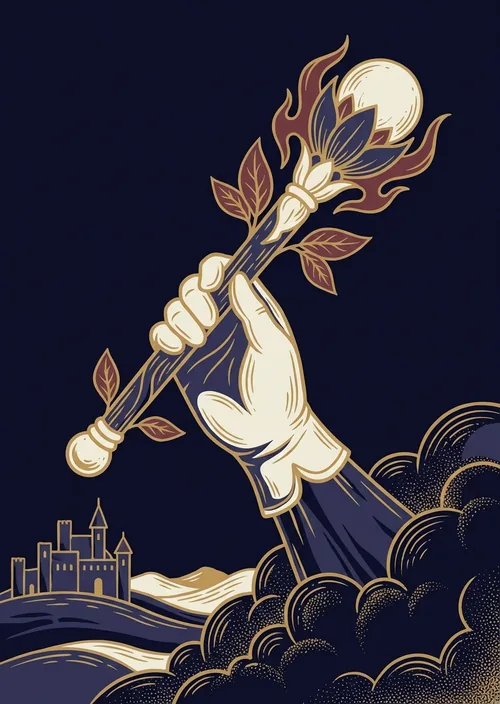
What the card shows
A hand comes out of a cloud holding a wooden staff that is still in leaf. Small leaves fall away from it. Below, a landscape with a river and a distant castle, which most decks keep vague on purpose. The branch is the whole image: cut wood that has not stopped growing.
The tradition reads it as a new impulse with real force behind it. The leaves matter because they make the offer alive rather than inert, something that will keep going on its own if it is taken up. The hand out of the cloud is common to all four aces and means the same thing each time, that this is presented to you rather than produced by you.
The castle in the distance is left indistinct in most decks, and readers usually leave it alone. What it contributes is scale. There is somewhere this could go, and it is far off, which keeps the card honest about how early a stage it describes.
Upright and reversed
Upright, the keywords are inspiration, new venture and energy. What separates this from the other aces is heat. The impulse is not neutral information or a resource, it is the wish to act, arriving with enough push that acting feels obvious.
Reversed, two readings are in common use. One is an idea that never caught, the offer made and nothing following from it. The other is enthusiasm that arrived and then left, which is the harder version because something did start. The way to tell them apart is whether the rest of the spread shows any activity at all. Nothing moving argues for the first, movement that has gone flat argues for the second.
Aces, and the suit of fire
An ace is the number one in its suit, and across all four suits the number means the same thing: a beginning in its pure form, unmixed and undeveloped. Nothing has been done with it yet. That is why aces feel promising and also why they are the least reliable cards in a spread. Potential is not a plan.
Wands carry fire, which the tradition assigns to will, drive and the wish to make something happen. So the Ace of Wands is one-ness in fire, the very start of wanting. Set against the Ace of Pentacles, which offers something material, the difference is clear. Pentacles hand you a thing. Wands hand you the urge, and what you do with it is not included.
The question it puts
There is no astrological ruler for this card in the usual correspondences. The minor arcana are assigned decans by the Golden Dawn system, but the aces sit outside that scheme and are treated as the root of their element rather than a slice of the zodiac. So the element is all you get, and fire is enough to work with.
As a prompt, the Ace of Wands asks something uncomfortable. If the impulse is real, what is stopping the first small step, and if you cannot name what is stopping it, was the impulse real. This site does not treat a drawn card as information about your future. It treats it as a question worth answering honestly, and this one is answerable today.
Aces also tend to reward being read alongside whatever follows them in the spread, since the next card often shows what the impulse actually attached itself to.
Questions people ask about this
What does the Ace of Wands mean?
A new impulse with genuine force behind it. The card describes the beginning of wanting to act rather than the action itself, which is why the tradition treats it as promising and unfinished at the same time.
What does the Ace of Wands mean reversed?
Either an idea that never caught or enthusiasm that arrived and then drained away. Whether anything in the spread shows movement is usually what decides between the two.
Does the Ace of Wands have an astrological ruler?
No. In the Golden Dawn scheme the numbered minors take decans, but the aces are treated as the root of their element instead, so this card carries fire and nothing more specific.
How is it different from the Ace of Pentacles?
Pentacles offer something material and real. Wands offer the urge to act, with no object attached. One can be picked up, the other has to be spent on something you choose.
Is the Ace of Wands about a job or a relationship?
The card does not specify. Aces describe the shape of a beginning, and the position it lands in and the cards around it are what give it a subject.
Can I draw this card here?
Yes. Every spread on the site draws from the whole deck in the page, reversals included unless you turn them off, and each reading rebuilds from its own link.