What the image shows
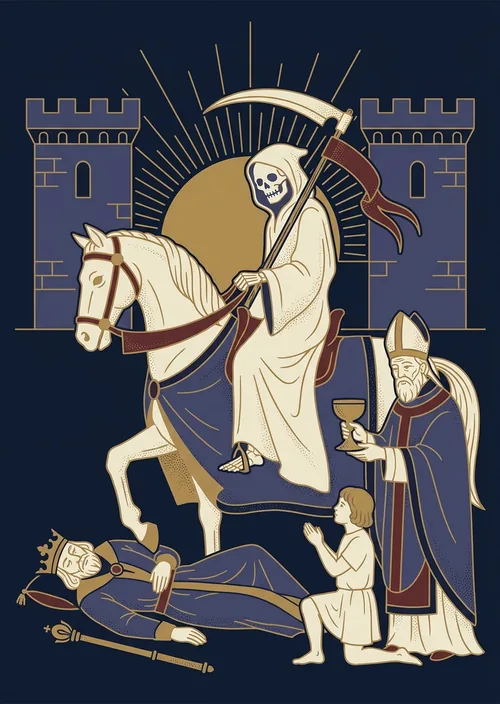
A skeletal rider in armour moves across the card on a pale horse, carrying a banner. Figures ahead of it react differently: one is already down, one kneels, one appears to be pleading, and a child watches without alarm. Behind them, between two pillars, the sun is either rising or setting and the card does not tell you which.
The detail worth noticing is that the rider is moving steadily rather than attacking. The tradition reads the figure as impersonal, something passing through that does not negotiate and does not single anyone out. The varied reactions in the foreground are the actual subject: the ending is fixed, and what differs is how people meet it. The child looking on without fear is in the picture for that reason.
Upright and reversed
Upright, the reading is that something is over. The card is about the ending, not about dying, and readers have said so for as long as the card has been interpreted. Its keywords are ending, transition and clearing, and clearing is the one that matters most in practice. What the tradition emphasises is the space afterwards, which cannot exist while the thing that ended is still being kept alive.
Reversed, the usual reading is holding on past the ending, which extends it rather than preventing it. That is a sharper claim than it first sounds, because it does not say the ending can be avoided. There is a second reading, less common, where the reversal points to a change that is finally beginning to move after being stuck. Whether the other cards describe resistance or release is what separates them.
Where it sits and what rules it
Death is the thirteenth trump, between Temperance and the Devil in most orderings, though decks vary and some place Temperance directly after it. Read as a sequence, the cards around it describe a passage rather than a stop. The card before it deals with what has been suspended or balanced, and the card after deals with what binds. Neither of those is a resting point, which is the argument against reading Death as the end of anything but a stage.
The correspondence is Scorpio, a water sign, in the Golden Dawn scheme that most modern decks follow. Scorpio is the sign the tradition attaches to what is hidden and to processes that finish whether or not they are watched, so the pairing reinforces the reading rather than adding to it. It is a nineteenth century assignment, not an old one.
The question it puts
The useful question this card asks is which thing in your life has already ended in fact while still being maintained in form. People are often clearer about this than they expect once the question is put plainly, and the difficulty is rarely in knowing the answer. It is in saying it where someone can hear it.
This site does not treat a card as information about the future, and it will not soften this one. Death is a difficult card and pretending otherwise would be dishonest. What it offers is not a prediction but a prompt about where your effort is going, and that is worth something whatever you think a deck can know.
Questions people ask about this
Does the Death card mean someone will die?
No. Readers have treated it as a card about endings and transitions rather than mortality for as long as the card has been interpreted, and this site makes no predictive claims of that kind.
What does Death mean reversed?
The usual reading is holding on past an ending, which extends it rather than preventing it. A less common reading has a stalled change finally starting to move. The surrounding cards decide which fits.
Which sign is Death linked to?
Scorpio, a water sign, in the correspondence set out by the Golden Dawn and inherited by most modern decks. It reinforces the card's existing reading rather than adding a new one.
Is Death a bad card to draw?
The tradition treats it as difficult rather than bad. It describes something being over and the space that opens once it stops being propped up, which readers often meet with relief as well as loss.
Why is the card numbered thirteen?
It holds the thirteenth place in the trump sequence, which is where its later reputation for ill fortune comes from. The number is a position in an ordered set, and the tradition attaches no separate meaning to it.
Can Death appear in any spread on this site?
Yes. Every layout draws from the full deck, reversals included unless you turn them off, and each reading can be reopened from its own link.