What the card shows
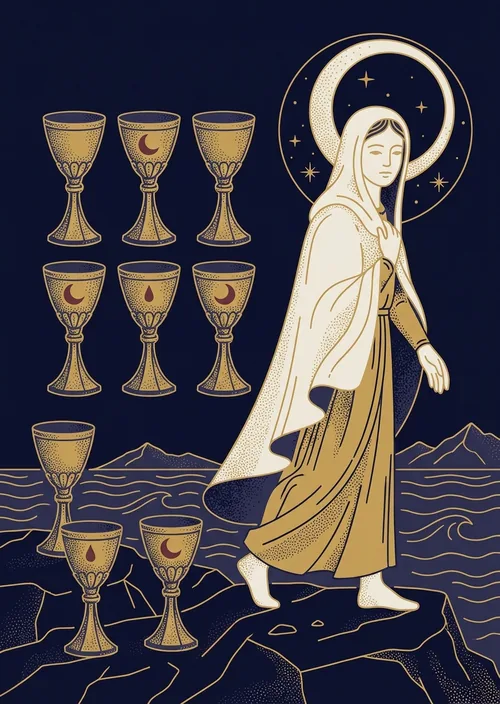
Eight cups stand upright in a stack with a gap in the top row. A cloaked figure walks away from them, uphill, with a staff, towards rocky ground. Overhead the moon is partly covered, showing both a full face and a crescent at once.
The tradition reads it as leaving a situation that works because it does not satisfy. The cups matter because they are intact. Nothing has gone wrong here in any way an outsider could point to, and the gap in the arrangement is the only sign of what is missing. The doubled moon is usually read as the mixed light people leave by, when they can see enough to go and not enough to be sure.
Upright and reversed
Upright the keywords are departure, seeking and walking away, and seeking is the one that keeps the card from being merely sad. The tradition does not read this as abandonment. It reads it as going after something the current arrangement cannot supply, without the card specifying what that is.
Reversed, three readings circulate. Staying past the point is the most common. Drifting without knowing why is the second, and returning is the third, which sits oddly with the others. What separates them is whether the surrounding cards show a situation still holding someone or a person already in motion. A spread with an anchor in it argues for staying. A spread with movement argues for drift or return.
Eights, and the suit of water
Eight is the number at which a suit's process is running and the early choices have hardened. In every suit the eight shows a person with fewer options than they had, which is why all four are somewhat uncomfortable cards and none of them is disastrous.
Water is feeling and attachment, so eight in water is attachment at the point where it has become a structure. Set beside the Eight of Swords, the pair is worth reading together. Both describe someone contained by a situation. In swords the containment is in the mind and the exit is open, while here the exit is being taken and what remains is the loss of something that was genuinely fine.
The question it puts
The site's data attaches no planet or sign here, so the correspondence is elemental. Water in the Golden Dawn scheme carries feeling, memory and attachment, and that is the whole of what can be said with any confidence about this card's ruler.
As a prompt it asks the hardest form of a common question. What are you keeping because it works rather than because you want it, and what would it cost to admit that. The card does not tell you to leave anything. This site takes a reading as a way of putting a question to yourself, and the value of this one is that it does not accept adequate as an answer.
Questions people ask about this
What does the Eight of Cups mean?
Leaving a situation that works because it does not satisfy. The cups in the image are upright and undamaged, so the card describes a departure that cannot be justified by anything having gone wrong.
What does the Eight of Cups reversed mean?
Most often staying past the point, sometimes aimless drift, occasionally a return. Whether the spread shows something still holding the querent or shows them already moving is what separates the readings.
Why is the moon shown twice?
The image combines a full moon and a crescent in one face. Readers usually take it as mixed light, enough to leave by and not enough to be certain, which fits a departure made without proof.
Is this a card about ending a relationship?
It can be, but the card names no subject. It describes leaving something adequate, which applies to work, a place or a habit as readily as to a person, and the surrounding cards supply the context.
How does it differ from the Eight of Swords?
Both show someone contained. In swords the constraint is mental and the exit is open but unseen, while here the exit is being walked through and the difficulty is the loss rather than the trap.
Can I draw this card in a reading here?
Yes. Spreads on the site shuffle the whole deck in the page, with reversals unless you turn them off, and each result can be reopened from its own link.