What the image shows
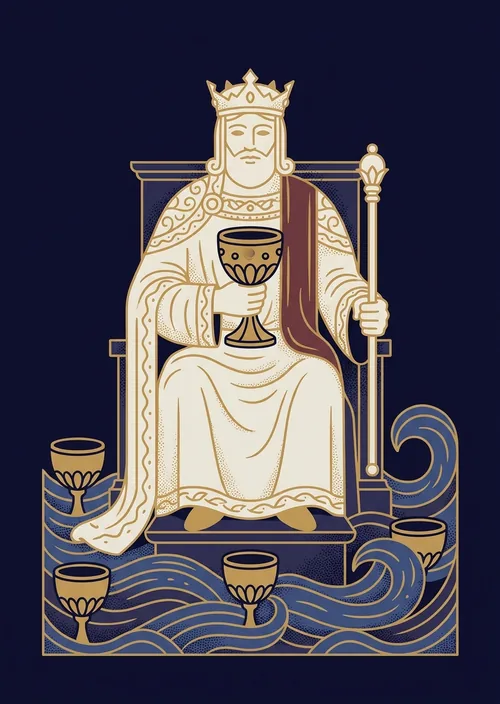
The throne sits on a slab in open sea, with waves around it. A ship rides in the distance on one side and a fish leaps on the other. The figure holds a cup in one hand and a short sceptre in the other, wears a fish pendant, and is entirely dry despite the water at every edge of the frame.
The dryness is the whole argument of the picture. Nothing about the sea is calm, and nothing about the figure is agitated by it. Readers usually note that the cup is held level and is not being looked at, which is read as feeling carried without being inspected constantly.
Upright and reversed
Upright, the reading is deep feeling under reliable control. Emotional maturity, calm and support are the words attached to it, and support is worth pausing on. This figure is traditionally read as the person others bring things to, precisely because the response will not be larger than the problem. The control is not read as distance. It is read as capacity.
Reversed, the split is genuine. In one version the control has become suppression, and the feeling is present but never let out, which the tradition treats as costly rather than admirable. In the other the control has slipped, giving volatility, and in its harsher form the emotional steadiness is being used on other people rather than for them. The surrounding cards decide, and the two call for opposite responses.
Kings, and the suit of water
Every suit closes with four court cards, and the king is conventionally the one that turns the element outward and applies it. What that means depends entirely on the element, and in water it produces something quieter than in the other three suits, because the outward application of feeling is mostly listening.
Water is read as feeling, attachment and what moves under the surface. A king in water is the element governed rather than dampened, which is why the picture shows a rough sea rather than a still one. As with the other courts, the card data here gives an element and no zodiacal correspondence, so rank and suit supply the reading. Many readers also take the courts as manners of acting rather than as people, which sidesteps the gendering of the ranks.
The question it puts
Read as a person, the question is who in your situation is absorbing the emotional weight, and whether anyone has asked what that costs them. Read as a manner of acting, the question is whether your own steadiness is capacity or avoidance, which is not always obvious from inside it.
This site treats a reading as a prompt for thinking rather than information about what is coming. The card does not tell you which of those you are doing. It describes the difference clearly enough that you can test it against your own week.
Questions people ask about this
What does the King of Cups mean upright?
Deep feeling under reliable control. The tradition reads the figure as someone others bring problems to, because the response will not be bigger than the problem. Control here means capacity rather than distance.
What does the King of Cups mean reversed?
Either control that has hardened into suppression, or control that has slipped into volatility. A harsher version has the steadiness used to manage other people. The surrounding cards separate them.
Why is the throne shown at sea?
The rough water is the point of the picture. The figure is dry and unbothered while the element is plainly in motion, which is the tradition's way of drawing feeling that is governed rather than absent.
Is the King of Cups a person in the reading?
It can be, and it can equally describe a way of acting. Which reading applies is usually settled by the question and by what the other cards in the spread are doing.
Does this card have an astrological correspondence?
Not in the data used here. The card carries water as its element and no sign or planet, so its meaning comes from the element and from its rank within the suit.
How does it differ from the Queen of Cups?
The convention is that the queen holds the element inwardly and the king applies it outwardly. Both are read as emotionally capable, and the difference is in direction rather than degree.