What the image shows
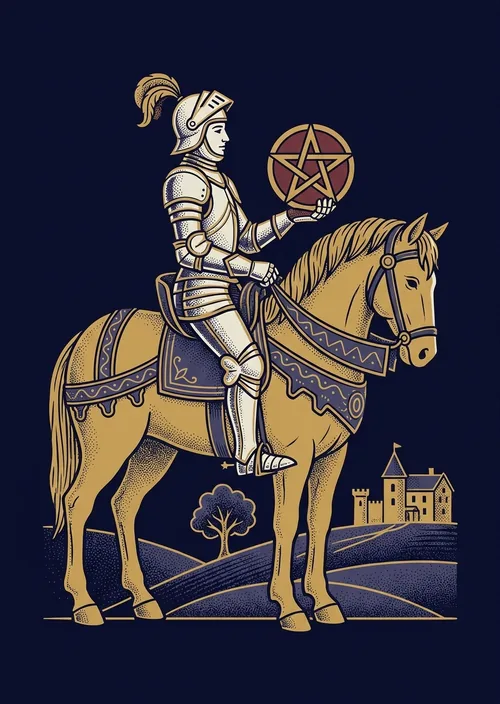
A knight in dark armour sits on a heavy black horse at the edge of a ploughed field. The horse has all four feet on the ground and its head is down. He holds a single coin out in front of him and is looking at it rather than at the road. Oak leaves decorate his helm and the horse's headpiece.
The stillness is the argument. Set beside the other knights, whose horses rear or gallop, this one reads as a rider who has assessed the ground first. The ploughed field behind him has already been worked, and the coin is held level and examined rather than carried. Readers take the oak leaves as endurance, the tree being the slowest and longest lived of the traditional set.
Upright and reversed
Upright, the reading is unglamorous, dependable and effective. Diligence, routine and reliability are the words attached to it. The card describes the person who finishes what was agreed, at the pace that was agreed, without needing to be interesting about it. The tradition is unusually plain here: this is the least exciting court card in the deck and it is the one you would want handling anything that actually matters.
Reversed, the reading is routine that has become a rut, and the reversed keywords pull in slightly different directions. Stagnation is the method still running after the reason for it has gone. Boredom is the person noticing that and doing nothing. Stubbornness is the harsher version, where the pace is being defended rather than merely kept. What decides between them is whether the neighbouring cards show anything asking to be changed.
Knights, and the suit of earth
The knights sit between the pages and the queens, and the convention most modern readers use gives them the element in motion, usually in excess. A knight takes one quality of the suit and does nothing else with it, which is why the other three come across as headlong. Excess in earth looks different from excess anywhere else.
Pentacles carry earth, read as work, money, the body and anything that must be built rather than decided. Taken to excess, earth does not accelerate. It slows down and refuses to stop, which is exactly what the still horse shows. The data used here gives earth as the element and no zodiacal ruler, so rank and suit carry the reading. Treating the courts as manners of acting rather than as people works well for this one.
The question it puts
The question is whether your current pace is chosen or inherited. Steadiness that was decided on is a genuine asset and steadiness that simply never got reviewed is something else, and from inside a routine the two feel the same because neither involves any friction.
This site reads tarot as a structured prompt for thinking rather than as a forecast. The card does not tell you to speed up and it does not congratulate you for being consistent. It asks when you last looked at the method you are using, and what would have to happen before you were willing to change it.
Questions people ask about this
What does the Knight of Pentacles mean upright?
Unglamorous, dependable and effective. Diligence, routine and reliability are the associated words, describing someone who finishes what was agreed at the pace agreed, without needing attention for it.
What does the Knight of Pentacles mean reversed?
Routine that has hardened into a rut. That covers a method still running after its purpose has gone, boredom noticed and ignored, and stubbornness where the pace is actively defended.
Why is his horse standing still?
The other three knights are shown in motion, so the stillness is a deliberate contrast. It is read as a rider who checks the ground before covering it, which fits the suit he belongs to.
Is the Knight of Pentacles a slow card?
Slowness is central to how it is read, though the tradition treats that as a method rather than a fault. What the card describes is progress that continues, not progress that is delayed.
What element does this knight belong to?
Earth, which covers work, money and the body. There is no sign or planet attached in the data used here, so the reading comes from the element and from the knight's place in the court.
How does he compare with the Knight of Wands?
Both are the element in motion and taken to excess. In fire that produces speed without follow through, and in earth it produces persistence that will not adjust. They fail in opposite directions.