Everything in the picture is moving
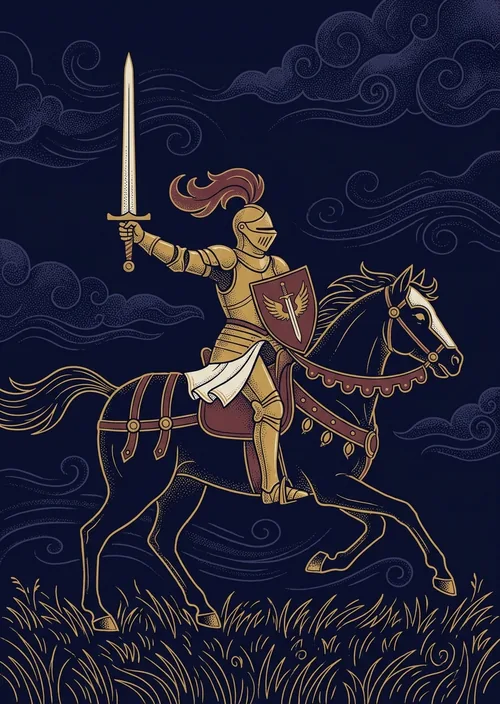
A knight in full armour charges from left to right with his sword raised above his head. The horse is at a flat gallop with its mane streaming and its head thrown forward. The trees in the background are bent hard by wind, the clouds are torn into streaks, and birds are being carried sideways across the sky.
What is worth noticing is that the wind is running the same way as the rider. Nothing in the frame is resisting him, and there is no visible opponent. He is charging at something outside the picture, which readers usually take as the point. The card describes the charge rather than the target, and the target is left entirely undefined.
Upright and reversed
Upright, the keywords are directness, urgency and decisiveness, and the card is genuinely positive about all three. It shows up for people who cut through a stalled conversation, name the problem out loud, and move first. When a spread has been full of hesitation, this arrival is usually the useful one, and the tradition does not apologise for the bluntness that comes with it.
Reversed, nothing slows down. That is the trick of this reversal and the reason it reads badly for the people around the querent rather than for the querent. The speed and the force remain and the judgement drops out, giving aggression, haste and tactlessness. In practice it looks like the argument won at the cost of the relationship, the message sent before the facts were in, or the true observation made to somebody who had not asked for it.
Knights, and the suit of air
Knights are the court rank that takes the element outward and puts it in motion, without the moderation the king and queen are credited with. Every knight therefore has a characteristic excess, and this is the one where that excess is most visible, because air moves faster than the other three elements and shows its motion in the sky.
Air is thought, conflict, truth and difficulty. Set that suit galloping and you get an idea pursued at speed, which is exactly as useful and as dangerous as it sounds. The data used here gives the card air and no zodiacal ruler, so rank and element carry the meaning between them. Reading the courts as manners of acting rather than as people helps a great deal with this one, since almost everyone has had a week in which they behaved like it.
When it turns up
The question worth sitting with is whether the thing you are about to say is true, or merely satisfying. Those overlap often enough to be confusing, and the card does not distinguish them for you. It only points out that you are already moving.
In an advice position it usually means go now and stop consulting people. In a position describing another person it is often a warning about pace rather than intent. A reading here is a structured prompt for thinking rather than a forecast, and this card mostly asks you to slow down long enough to check the direction, which is not the same as asking you to stop.
Questions people ask about this
What does the Knight of Swords mean upright?
Speed and directness, used well. Naming the problem out loud, cutting through a stalled situation and moving first. The tradition treats the bluntness as part of the value rather than a flaw.
What does the Knight of Swords mean reversed?
The same speed with the judgement removed. Aggression, haste and tactlessness, which in practice looks like the argument won at the cost of the relationship it was had inside.
Is the Knight of Swords a warning?
Sometimes, though not always. Upright it can be the one useful card in a hesitant spread. It becomes a warning mainly when the surrounding cards suggest the target has not been thought about.
Why is there no opponent in the picture?
He is charging at something outside the frame. Readers take that as deliberate, because the card describes the charge itself and leaves what it is aimed at completely undefined.
Does this card have a sign or planet?
Not in the data used here. It carries air as its element with no zodiacal correspondence, so the meaning comes from air and from where the knight sits among the court ranks.
Can it describe a real person?
It can, and it can equally describe a way you are currently acting. Treating the courts as manners of acting rather than as people is the more forgiving reading and often the more accurate one.