What the image shows
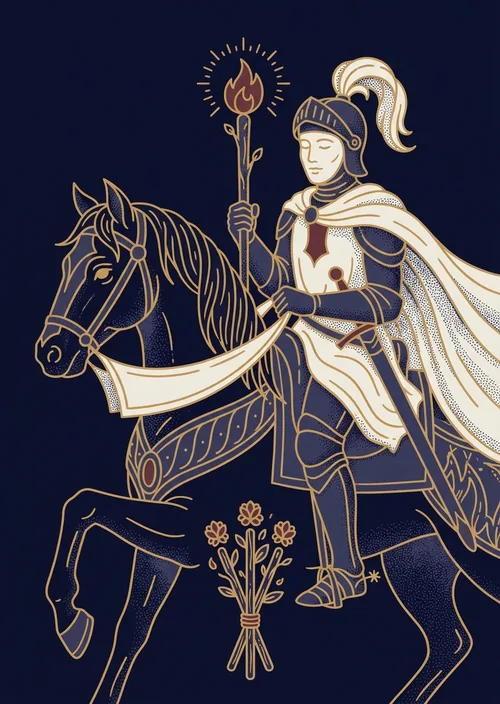
A young knight in armour sits a rearing horse and holds a staff that is in leaf rather than a lance. Salamanders run across his tunic and along the horse cloth, and a plume of red feathers streams back from his helmet. The ground is bare, with low pyramids in the distance and nothing drawn between him and them.
Readers dwell on the horse more than on the rider. It is the one mount in the deck caught mid rear, which places the picture a moment before movement rather than during it. The visor is up, so the figure is looking ahead and can be seen doing it. What the tradition takes from the emptiness of the ground is that no obstacle has been drawn there, and that none has been checked for either.
Upright and reversed
Upright, the reading is committed movement, sometimes before the ground was checked. Boldness, haste and adventure are the words attached to it, and the middle one does quiet work. The card is not read as courage weighed and then applied. It is read as the decision already taken, with the person now inside it and travelling.
Reversed, the accepted readings pull in opposite directions. One is energy with nowhere to go, which shows as frustration or stalling, a charge held with the brakes on. The other is a charge in the wrong direction, which is recklessness rather than blockage. What decides between them is whether the rest of the spread describes obstruction or momentum. Cards about waiting, refusal and delay point to the first. Cards about conflict or overreach point to the second, and reading one as the other wastes the spread.
Knights, and what fire adds
Every suit closes with a court of four, and the knight is conventionally read as the suit in motion. The page in the same suit is learning the element, the queen holds it inwardly, and the king applies it with settled judgement. The knight does none of that. He carries the element outward at speed, which is why knights are usually read as a manner of going about something rather than as stable characters.
Wands carry fire, taken as will, initiative and the direction energy gets pointed. Fire in motion is therefore drive with a heading and no brake described anywhere in the picture. The card data used here gives the suit element and no sign or planet, which is the usual arrangement for court cards, so position within the suit does the work a sky correspondence would otherwise do.
The question it puts
If the card is standing for a person, the question is what they are riding towards and whether anyone has looked. If it is standing for a manner of acting, the question turns back on you. What did you commit to before checking, and would you commit to it again now that the ground is in view.
This site treats a tarot card as a prompt for thinking rather than a report on what is going to happen. Nothing here says the ride ends well or badly. The tradition offers a precise description of speed without survey, and the checking is yours to do.
Questions people ask about this
What does the Knight of Wands mean upright?
Committed movement, sometimes before the ground was checked. Boldness, haste and adventure are the keywords, and the card describes a decision already taken rather than one being weighed.
What does the Knight of Wands mean reversed?
Either energy with nowhere to go, read as frustration and stalling, or a charge in the wrong direction, read as recklessness. The surrounding cards settle which, since the two call for opposite responses.
Is the Knight of Wands a person or a situation?
It can be read either way. Court cards stand for people and for manners of acting, and the question asked usually decides. Read as a manner of acting it describes speed, not character.
How does it differ from the King of Wands?
The convention is that the knight acts and the king decides. Both carry fire, but the king's authority is built from experience, while the knight is movement without that settled judgement behind it.
Does the Knight of Wands have a zodiac sign?
Not in the deck data this site uses, which gives fire as the element and no planetary or zodiacal ruler. Some systems assign signs to the courts, and that layer is not applied here.
Why is the horse drawn rearing?
It is the only mount in the deck shown mid rear, which puts the image just before movement rather than in the middle of it. Readers take that as commitment made and not yet tested.