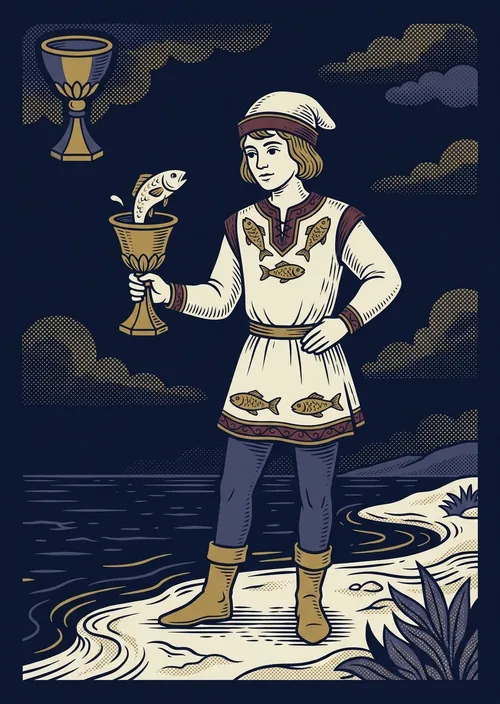
A cup with a fish looking out of it
A young figure in a long tunic of flowers stands by the sea, holding a golden cup at chest height. A small fish has put its head up out of the cup and appears to be looking back at the figure, who is looking at it with an expression somewhere between surprise and delight. The water behind is choppy but not stormy.
The fish is the whole card. It is something that has surfaced by itself, from a place the figure does not control, and it has arrived while the cup was simply being carried about. Readers take it as a feeling, an impulse, a piece of imagination or an unexpected tenderness. The important detail is that nothing is being done with it yet. The figure is holding the cup out, and the card stops there, before anyone has said whether the offer is welcome.
Upright and reversed
Upright, the reading is an early feeling offered nervously. Sensitivity, invitation and imagination are the keywords, and the nervousness matters as much as the feeling does. This is not a card of confident affection. It is the stage where somebody says the smaller version of what they mean and watches your face while you answer. Readers who turn it into a guaranteed romance are adding a promise the card does not make.
Reversed, two handlings are current and they point in different directions. The first is immaturity and moodiness, a feeling that is real but is being expressed at the wrong volume or aimed at the wrong person. The second is blocked expression, a feeling that cannot find its way out at all, held in until it sours. Look at what surrounds it. Cards about other people, arguments or sulking favour the first. Cards about isolation, silence or waiting favour the second.
Pages, and what the suit of water adds
The court runs page, knight, queen, king, and most modern readers take that as a scale of mastery rather than of social rank alone. A page has only just met whatever the suit governs. That is why pages are read as students, apprentices and children, and equally as an adult who is genuinely new at something, which is a state nobody outgrows permanently.
Cups are water in the Golden Dawn scheme that most modern decks follow, and water covers feeling, attachment and the inner life. A beginner in water is therefore easily moved and easily embarrassed by being moved. Set it beside the Page of Swords, a beginner in air, who meets the world with questions rather than with feelings, and the difference in temperament is clear. The site's deck data records an element for this card and no planetary attribution, which is normal for the court in the tables most decks use.
What it asks the reader
A tarot reading is a structured way of putting a question to yourself, not a report on what is coming. The question here is whether there is something you have felt recently and have been keeping at the size of a hint, in case saying it plainly would be too much.
The card does not say the feeling will be well received, and it would be dishonest to pretend it does. Plenty of tentative offers are declined. What the tradition observes is narrower and more useful: that the tentative stage is where most feelings are quietly abandoned, not because they were wrong but because holding them out felt undignified. Reversed, the question turns around and is no gentler. It asks whether the feeling is coming out sideways, in moods and small cruelties, because it has not been given anywhere honest to go.
Questions people ask about this
What does the Page of Cups mean?
An early feeling that is being offered nervously. Sensitivity, invitation and imagination sit around it. The card says nothing about whether the offer will be accepted.
What does the Page of Cups reversed mean?
Either immaturity and moodiness, or a feeling that cannot find its way out and has been held in too long. The surrounding cards decide which. Company and friction suggest the first, silence and isolation the second.
Is the Page of Cups a love card?
It is often read that way, because Cups govern feeling and attachment. It can equally cover a creative impulse or a tenderness towards a friend. Nothing in the card restricts it to romance.
What does the fish in the cup represent?
Something that has surfaced on its own from a place the figure does not control. Readers take it as an impulse, a piece of imagination or an unbidden feeling that arrived without being sent for.
Can the Page of Cups stand for a person?
Yes, often a young person or someone gentle and easily moved. It can also describe an adult who is new to the kind of feeling in question rather than new to life.
How is it different from the Ace of Cups?
The Ace is the opening of feeling itself, unattached to anyone. The Page is a person holding some of that feeling out to somebody in particular and waiting to see what happens.