What the image shows
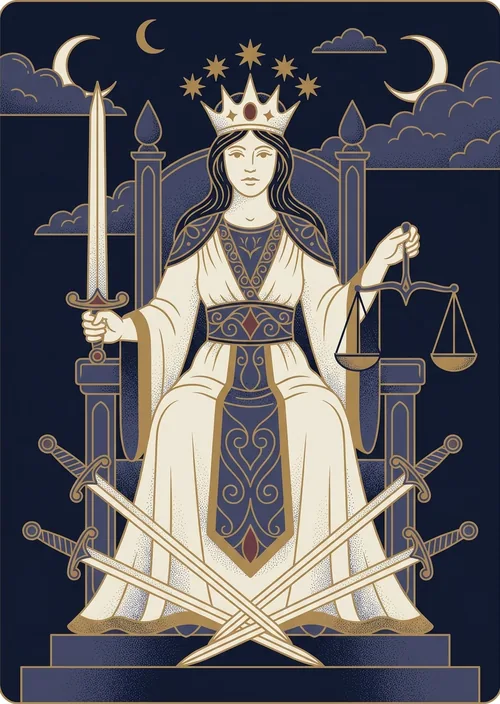
A queen sits on a throne carved with a winged head and butterflies, holding an upright sword in her right hand. Her left hand is raised, open, at about the height of her shoulder. Clouds sit below her, a single bird flies above, and the trees at the edge of the picture are bending in wind.
The raised open hand is the detail worth noticing, because it is not a defensive gesture. Readers usually take it as receiving or inviting, which sits oddly beside the sword and is meant to. The blade is vertical rather than angled, so it is being held rather than swung, and no one is drawn in front of it. Alone among the queens she is drawn in profile, facing sideways, which the tradition reads as attention on something outside the frame and not on you.
Upright and reversed
Upright, the reading is someone who sees the situation exactly and says so. Perception, honesty and independence are the keywords, and independence is there because this figure is traditionally read as having no stake in flattering anyone. That is what makes the assessment worth having. The tradition does not claim the reading is kind, only that it is accurate.
Reversed, the standard reading is clarity hardened into coldness. In practice it separates into bitterness, where accurate perception has soured into grievance, and harsh judgement, where the same clarity is used to cut rather than to describe. Cards about the past and about loss point towards bitterness. Cards about other people and conflict point towards judgement. Both readings share the same root, which is why the reversal so rarely reads as simple confusion.
Queens, and what air adds
Each suit closes with a court of four, and the queen is conventionally read as the element held inwardly. The knight moves with it, the king applies it and the queen contains it. That is a convention of the deck rather than a statement about people, and it is common now to read the courts as manners of holding an element instead.
Swords carry air, taken as thought, language and judgement. Air held inwardly is perception that has been thought through before it is spoken, which is why this queen is read as exact rather than merely blunt. The data used here gives the suit element and no sign or planet, as it does for every court card, so her place in the suit carries the meaning on its own. Readers who want a sign here are importing it from a scheme this deck does not use.
The question it puts
If the card stands for a person, the question is whether you want the truth from them or only agreement, because you will get the first. If it stands for a manner of acting, the question is whether your own clarity is still describing the situation or has begun cutting at it.
The site's position is that a card is a prompt rather than a forecast. This one does not tell you to soften. It marks the narrow distance between seeing clearly and seeing coldly, and leaves you to work out which side of it you are standing on. Nobody else in the spread will make that call for you.
Questions people ask about this
What does the Queen of Swords mean upright?
Someone who sees the situation exactly and says so. Perception, honesty and independence are the keywords, and the tradition values the assessment for being accurate rather than for being kind.
What does the Queen of Swords mean reversed?
Clarity hardened into coldness. It separates into bitterness, where perception has soured, and harsh judgement, where clarity is used to cut. The rest of the spread points to which applies.
Is the Queen of Swords a cruel card?
Not upright. The tradition reads her as unflattering rather than unkind, and the value of the card lies in an assessment made by someone with no stake in telling you what you want.
Why is she shown in profile?
She is the only queen drawn facing sideways rather than towards the viewer. Readers take that as attention directed at something outside the frame, and as a refusal to perform for whoever is looking.
What is her raised hand for?
The open left hand is usually read as receiving or inviting rather than defending. It sits deliberately at odds with the upright sword, and the tension between them is part of the card.
Does the Queen of Swords have an astrological ruler?
Not in the deck data used here, which gives air as the element and nothing else. Court cards on this site take their meaning from position within the suit rather than from a sign or planet.