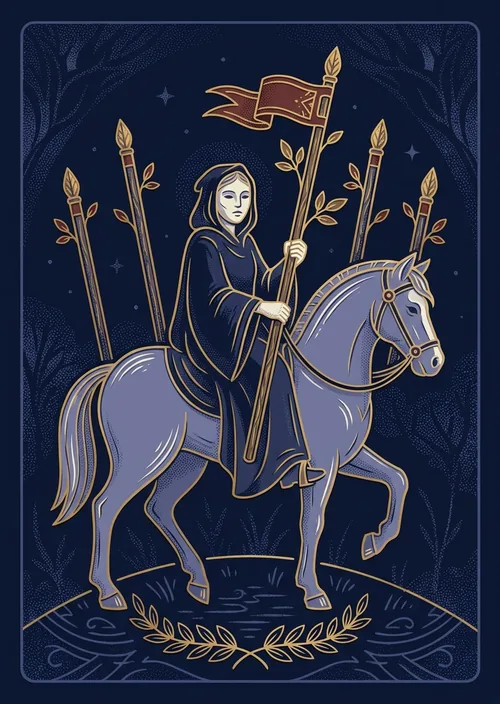
What the card shows
A rider passes on a white horse wearing a laurel wreath, with a second wreath tied to the staff he carries. Around and behind him walk figures holding the other five wands, and the crowd is drawn as a procession rather than a battle. The scene is a return, not a fight. Whatever happened has already happened, and what the picture records is the reception.
That detail sets the card apart from the Seven of Wands, where the position is still being defended, and from the Five, where the contest is under way. Here the outcome is settled and the interesting part is that other people know about it.
Upright and reversed
Upright, the meaning most decks give is the effort seen and credited, with success, acknowledgement and confidence as its keywords. The acknowledgement half is the one to hold on to. The card describes recognition arriving from outside, which is a different thing from a private sense of having done well, and it often appears where someone has been working without an audience and the audience has finally turned up.
Reversed, the accepted readings run along two lines. One is work that went unnoticed: the thing was done and nobody registered it, which is the more common modern reading. The other is a win that felt hollow, where the credit arrived and turned out not to be worth what it cost. The rest of the spread decides. Cards about other people and their attention point at the first, cards about the querent's own state at the second. A third and older reading takes the reversal as a straightforward reversal of fortune, and some readers still use it.
Six-ness, and the suit of fire
Across all four suits, six follows the difficulty of five and reads as an equilibrium regained. The Five of Wands is squabbling, the Five of Cups is loss, the Five of Swords is a fight won badly, the Five of Pentacles is exclusion. Each six settles that suit's five in the terms the suit understands. In cups the settlement is emotional and comes through memory, in pentacles it is material and comes through exchange, in swords it is physical and comes through leaving.
Wands is the suit of fire: action, drive, work, ambition, the will to start things. Six in that suit therefore settles a contest of energy, and it settles it the way fire does, in public and visibly. That is why the Six of Wands is about recognition specifically rather than about satisfaction. The minor suits carry no astrological sign in the standard scheme, only the element, which for wands is fire in the Golden Dawn framework most modern decks follow.
The question it puts
A reading here is a prompt for thinking rather than a claim about the future. The Six of Wands asks something a little uncomfortable: how much of what you are working towards is the thing itself, and how much is being seen doing it?
Neither answer is wrong. Wanting credit is not a flaw, and the card does not treat it as one. But the reversal exists because the two can come apart, and the card is at its most useful when it makes you check which of them you are actually chasing.
Questions people ask about this
What does the Six of Wands mean?
It describes effort that has been seen and credited. Success, acknowledgement and confidence are the keywords, and the acknowledgement is central: the card is about recognition arriving from outside rather than private satisfaction.
What does the Six of Wands mean reversed?
Usually either work that went unnoticed or a win that felt hollow. Cards about other people nearby favour the first reading and cards about the querent's own state the second. Some readers also keep the older sense of a reversal of fortune.
How is it different from the Seven of Wands?
In the Six the outcome is settled and the picture records the reception. In the Seven the position is still being defended. One card is a return, the other is a stand still being made.
What does the number six mean in tarot?
Six generally reads as equilibrium regained after the difficulty of the five. Each suit resolves its own five in its own terms, which is why the four sixes look so different from one another despite sharing a number.
Does the Six of Wands mean I will win?
This site makes no predictive claims. The card is a prompt about recognition, and the useful question it raises is how much of what you want is the achievement and how much is being seen to achieve it.
What element is the Six of Wands?
Fire, as with the whole wands suit, in the Golden Dawn correspondences that modern decks use. The minor cards carry no zodiac sign in that scheme, only the suit element.