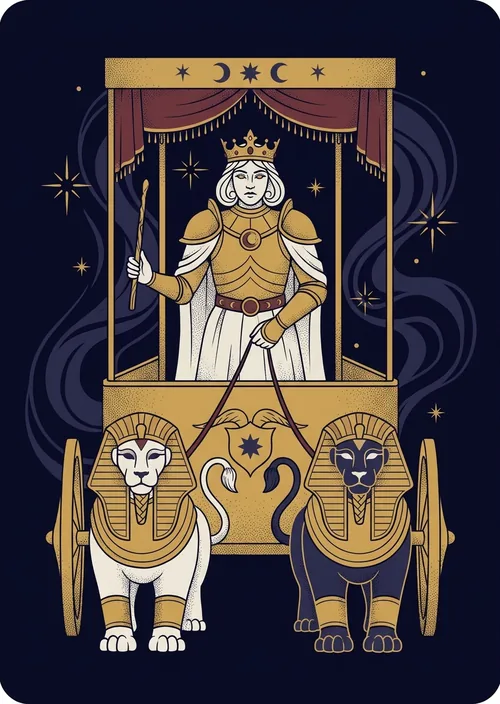
What the card shows
An armoured figure stands in a chariot drawn by two sphinxes, one black and one white, facing slightly apart. The detail readers return to is that there are no reins. Whatever holds the animals on course is not mechanical, and the tradition takes that literally: the control in this card is held by attention and will, and it lasts exactly as long as they do.
The canopy of stars overhead and the city behind are part of the same reading. Something has been left, deliberately, and the journey is under way rather than finished. That is why treating the card as a straightforward win misses most of what it says.
The armour is worth noticing as well. It is ceremonial rather than practical, closer to a shell than to battle gear, and readers who work with the image closely tend to treat it as the card admitting how much protection the driver needs to keep going.
Upright and reversed
Upright, the meaning is opposed forces held together long enough to get somewhere. Will, direction and control are the keywords, and none of them describes ease. The card is about maintaining a course through effort that cannot be relaxed, which is a real achievement and also a costly one.
Reversed, the accepted readings pull apart. One is effort without direction, the sphinxes going their own ways and the energy scattering. The other is a direction pursued well past the point of sense, control turned rigid. What decides between them is usually whether the surrounding cards show movement or stalling. A spread full of stalled cards argues for the first, a spread with momentum in it argues for the second.
Seventh in the sequence
The Chariot is the seventh trump, following the Lovers and preceding Strength. That placement carries weight. The Lovers is the card of a choice made between things that both have a claim, and the Chariot is what comes after choosing: holding to it while the parts you did not choose still pull.
Strength, which follows, does the same job by a different method, with an open hand rather than armour. Reading the two together is the quickest way to see the limit of the Chariot. Control by force of will works, and it does not scale, and the sequence knows that.
Water, Cancer, and the question it puts
The correspondence most modern decks use gives The Chariot the element water and the sign Cancer, following the Golden Dawn attributions rather than anything medieval. Cancer surprises people who expect a martial card to get a martial sign, but the fit is the armour. The card is protective as much as it is driving, a hard shell around something that would rather not be exposed.
As a prompt, the question is narrow and useful. What are you currently holding together by effort alone, and what happens to it the moment your attention goes elsewhere. The card makes no claim about whether you will arrive. It asks what the steering is costing.
It is a fair question to sit with whether or not you think a card can know anything, and it is one you can actually answer from where you are standing.
Questions people ask about this
Does The Chariot mean success?
It describes a course being held rather than a destination reached. The tradition reads progress in it, but the progress depends on continued effort, which is why calling it a victory card overstates the case.
Why are there no reins in the image?
Their absence is the point most readers draw on. The sphinxes are held on course by the driver's will rather than by any mechanism, so the control in the card lasts only as long as the attention behind it.
What does The Chariot mean reversed?
Either scattered force with no direction, or a direction pushed past the point of sense. Whether the rest of the spread shows movement or stalling is usually what decides which reading applies.
Why is The Chariot given Cancer?
The attribution comes from the Golden Dawn system used by most modern decks. The link is the armour and the shell, the protective side of the card rather than the driving side.
How does The Chariot relate to Strength?
They solve the same problem in opposite ways. The Chariot holds opposed forces by will and armour, Strength by patience and an open hand, and the sequence places them next to each other for that contrast.
Can this card be drawn on the site?
Yes. Each spread here draws from the full deck in the page, reversals included unless you switch them off, and the result can be reopened from its own link.