What the image shows
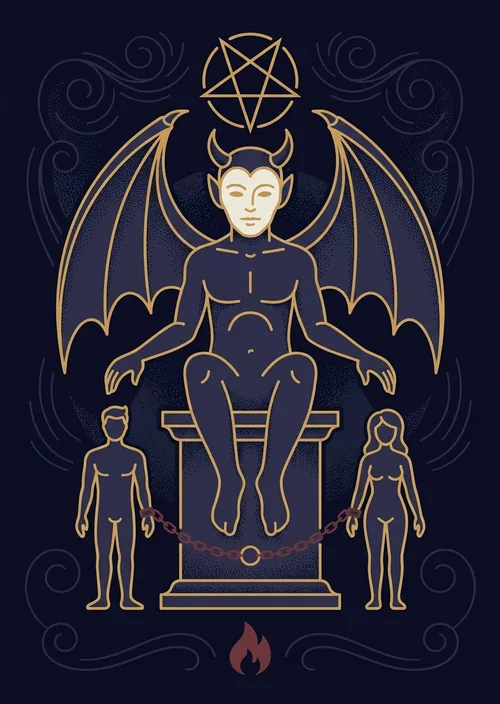
A horned figure sits above two smaller figures who are chained to the block beneath it. The chains hang loose around their necks. Both of the chained figures have small horns and tails of their own, which is usually read as the arrangement having changed them over time.
The slackness of the chains is the working detail. A reader who misses it produces the crude version of the card, which is helplessness. A reader who notices it produces the version the tradition actually teaches, which is that the restraint is real, uncomfortable and not locked. That is a more awkward reading and a more accurate one.
The horned figure above is read less as a person than as the shape the arrangement has taken. It is what the bind looks like once it has been given authority, which is why the picture puts it on a block rather than in motion.
Upright and reversed
Upright, the keywords are attachment, compulsion and material bind. The card covers habits, arrangements and appetites that are being maintained, including ones that were entered for good reasons and outlived them. It does not moralise about which. Money, work and the body sit here as readily as anything more dramatic, and often more usefully.
Reversed, the reading is the moment the chain is noticed, and the beginning of getting out. It is the rare reversal that most readers treat as an improvement on the upright, though the tradition is careful about how far that goes. Noticing is not the same as leaving, and a reversed Devil beside difficult cards is generally read as the recognition arriving rather than the exit completing. The surrounding cards say how far along the process is.
Where it sits in the sequence
The Devil is the fifteenth trump, between Temperance and the Tower. That run is one of the clearest arguments in the deck. Temperance is balance held by careful adjustment, the Devil is what happens when the adjustment hardens into an arrangement nobody questions, and the Tower is that arrangement collapsing.
Read in order, the Devil is a middle term and not a verdict. This matters when it appears with the Tower in the same spread, which readers often treat as doubly bad news. In sequence terms the pairing is closer to a description of a bind and its ending.
It also puts a limit on how final the card can be read. Nothing in the trumps stops at fifteen, and treating the Devil as a conclusion ignores the two cards the ordering places directly after it.
Capricorn, earth and the question it puts
The element is earth and the sign is Capricorn, from the Golden Dawn correspondence carried by most modern decks. Capricorn covers structure, endurance and material ambition, and that attribution is why the card so often reads as something built up steadily rather than fallen into overnight. Binds of this kind are constructed, usually by small sensible decisions.
The prompt is uncomfortable and worth keeping uncomfortable. What are you continuing to do that you would not choose again today, and what does continuing it buy you. The card makes no claim about whether you will stop, and this site does not make one either.
The follow up question is the harder one. If the arrangement buys you something real, and it usually does, then leaving it costs that thing, and any honest reading of this card has to include the cost.
Questions people ask about this
Is the Devil an evil card?
No. The tradition reads it as attachment and compulsion rather than wickedness. The chains in the picture are loose, and that detail is what the standard reading is built on.
What does the Devil mean reversed?
The usual reading is recognition and the start of release. Reversed beside difficult cards it tends to mean the chain has been noticed rather than removed, so the rest of the spread matters.
Why are the chains loose?
The looseness is deliberate in the traditional image. It marks the bind as one that is maintained rather than imposed, which is what separates this card from simple helplessness.
What sign rules the Devil?
Capricorn, with earth as the element, in the Golden Dawn scheme most modern decks use. Capricorn's associations with structure and endurance explain why the card reads as something built up slowly.
What does it mean with the Tower?
The two sit next to each other in the trumps, and the sequence reads as a bind followed by its collapse. Readers often treat the pairing as doubly bad news, which the ordering does not support.
Does it mean addiction?
It can be read that way, but the tradition is broader and covers any arrangement kept going past its usefulness. Nothing on this site is medical advice, and a card is not a diagnosis.