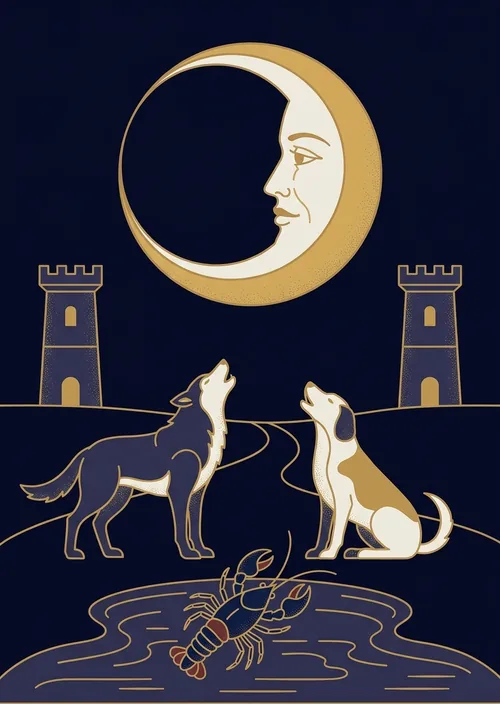
A path between two towers
The standard image is a night scene: a crayfish crawling from a pool, a dog and a wolf howling, a track running between two towers and away into hills. The moon in the sky has a face and drops of light falling from it. Almost nothing in the picture is fully lit, and that is the design rather than a mood.
The dog and the wolf are the detail most readers use. They are the same animal, one tame and one not, and at night you cannot reliably tell which is which. The tradition reads the card as the moment when your ability to distinguish is impaired, not the moment when something is actually hiding from you. Those are different problems and the card is about the first.
Upright and reversed
Upright, the reading is working with incomplete information and the anxiety that produces. Uncertainty, illusion and instinct are the keywords, and instinct belongs there because the card describes the conditions in which people fall back on it. Sometimes that is the right call. The card does not say it is.
Reversed, two readings compete and both are common. One is the fog lifting, information arriving, a shape resolving into something ordinary. The other is a fear finally identified as a fear, which is not the same relief but is a real one. There is a third handling in which the confusion is only now becoming conscious. Surrounding cards decide between them, and so does the simple question of whether the querent has recently learned something.
Where it falls among the trumps
The Moon is the eighteenth trump, placed after the Star and before the Sun. That run is usually read as a night sequence: the Star is quiet and restorative, the Moon is the difficult stretch in the middle of the dark, and the Sun is plain daylight in which things are simply what they are. Reading the Moon on its own tends to make it heavier than the sequence intends.
Its element is water and its sign is Pisces, in the Golden Dawn correspondences that most modern decks took up. Pisces in that system is the sign least interested in hard edges, which fits a card about the failure of outlines. The scheme is a nineteenth century construction and worth naming as one.
The honest reading
A tarot reading is a structured prompt, not a source of facts about what is coming. The Moon puts a hard question and does not soften it: what are you currently treating as known that you actually only suspect. That question is uncomfortable in proportion to how much has been built on the suspicion.
The second half is more practical. If you cannot get the information, the tradition does not tell you to wait indefinitely, because the card is about acting under uncertainty rather than avoiding it. It asks you to be clear with yourself about which of your reasons are evidence and which are the dog you have decided is not a wolf. No card knows which it is.
Used that way the Moon is one of the more useful cards in the deck, because the confusion it names is ordinary and the sorting it asks for can actually be done. It does not tell you what is out there in the dark, and it should not be read as though it did.
Questions people ask about this
What does the Moon card mean?
Working with incomplete information, and the anxiety that follows from it. The tradition treats it as a state of impaired judgement rather than as evidence that someone is deceiving you.
Does the Moon mean someone is lying to me?
Not in itself. Illusion is one of its keywords, but the image is about the difficulty of telling things apart in poor light. Reading it as an accusation adds a claim the card does not make.
What does the Moon reversed mean?
Usually the fog lifting, or a fear finally recognised as a fear rather than a fact. Some readers also take it as confusion only now becoming conscious. The rest of the spread decides which is meant.
What sign rules the Moon card?
Pisces, with water as the element, under the Golden Dawn correspondences used by most modern decks. That is a nineteenth century system rather than an ancient one.
Why does the Sun come after the Moon?
The trumps run in a set order and the pairing is deliberate. The Moon is the difficult part of the night and the Sun is ordinary daylight, so reading the Moon as a conclusion misses that it is a middle term.
Can I get this card in a reading here?
Yes. Spreads on the site draw from the complete deck, reversals included unless you switch them off, and every reading rebuilds from its own link if you want to look at it again.