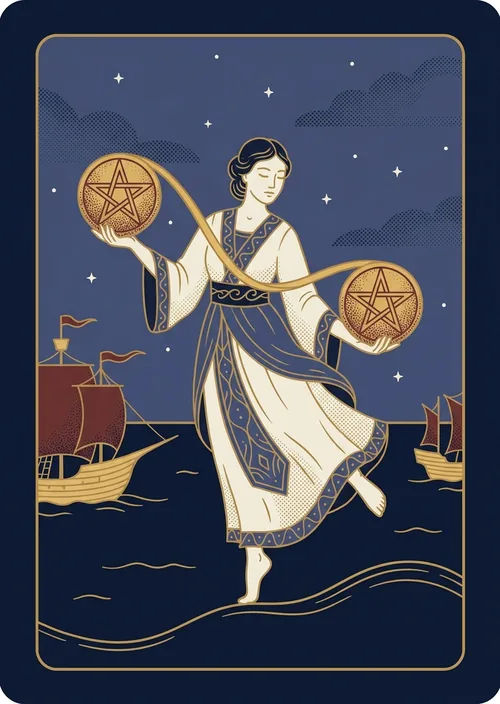
A juggler, two coins and rough water
A figure in a tall red hat stands with weight on one foot, almost dancing, juggling two coins that are linked by a green band looped into a figure of eight. Behind, the sea is heaving and two ships are riding steep waves. The figure is not looking at the ships.
The picture works by splitting your attention exactly as its subject does. In front there is skill and something close to enjoyment. Behind there are conditions that nobody in the picture controls. Readers take the looping band as the endless motion the juggling requires, since the coins are never both at rest. Nothing has gone wrong, and nothing about the scene suggests it can be held indefinitely.
Upright and reversed
Upright, the reading is managing more than one thing competently for now. Balance, adaptability and priorities are the keywords, and the competence deserves crediting rather than warning about. Somebody is handling a genuinely awkward arrangement well. The card simply declines to call that a stable state, because the effort required is part of what it depicts.
Reversed, the juggling fails, and it usually fails in one of two ways that are worth telling apart. The first is overcommitment: too much was taken on and the arithmetic was never going to work. The second is disorganisation, where the load was manageable but the handling was not, and something got dropped that did not have to be. Cards about pressure, money or demands from others point at the first. Cards about muddle, delay or forgotten things point at the second.
Twos across the suits, and what earth adds
Every pip is read as its number expressed through its suit. Twos are the first pairing after an ace, so they concern duality, meeting and the tension between one thing and another. The Two of Cups is a pairing of feeling, the Two of Wands is a decision about where to aim, and the Two of Swords is a choice held in deliberate suspension.
Pentacles are earth in the Golden Dawn scheme that most modern decks follow, and earth governs money, work, the body and time. Duality in earth is not a philosophical problem, it is a diary. Two things that both need doing, with hours that cannot be extended, is the whole subject of the card. That is why it reads so practically compared with the other twos. The pips carry a planet and sign in the fuller Golden Dawn tables, though the data behind this page records the element only.
What it asks
Tarot works as a prompt for honest thinking rather than as a forecast, and this card puts a fairly precise question. It asks what you are currently keeping in the air, and whether you have been treating an arrangement that costs you constant effort as though it were simply your life now.
It does not say the juggling will fail. It observes that the state in the picture is motion, not rest, and that the ships in the background are a reminder of conditions that were not consulted. Reversed, the question narrows further and is less comfortable: when it came apart, was it because you took on too much, or because you handled a reasonable amount badly? Those have different remedies, and the card is more useful when the answer is not softened.
Questions people ask about this
What does the Two of Pentacles mean?
Managing more than one commitment at the same time, competently for the moment. Balance, adaptability and priorities are the keywords, with the effort involved treated as part of the picture.
What does the Two of Pentacles reversed mean?
The juggling failing, either through overcommitment or through disorganisation. Cards about pressure and demands suggest too much was taken on, while cards about muddle suggest the load was mishandled.
Is the Two of Pentacles about money?
Often, because Pentacles cover money and work, but it applies to time and energy just as readily. Any pair of commitments competing for the same limited resource fits the card.
What do the ships in the background mean?
Readers take them as conditions outside the juggler's control, moving on rough water while attention is fixed on the coins. They are a reminder that circumstances are part of whether the arrangement holds.
Does this card mean I should drop something?
It does not give instructions. It describes an arrangement kept going by continuous effort and asks whether that has been mistaken for stability. What to do about it is outside what the card claims.
Why is the figure dancing?
The posture makes the point that the handling is skilled rather than desperate. Reading the card as struggle from the start misses the competence the image is at pains to show.