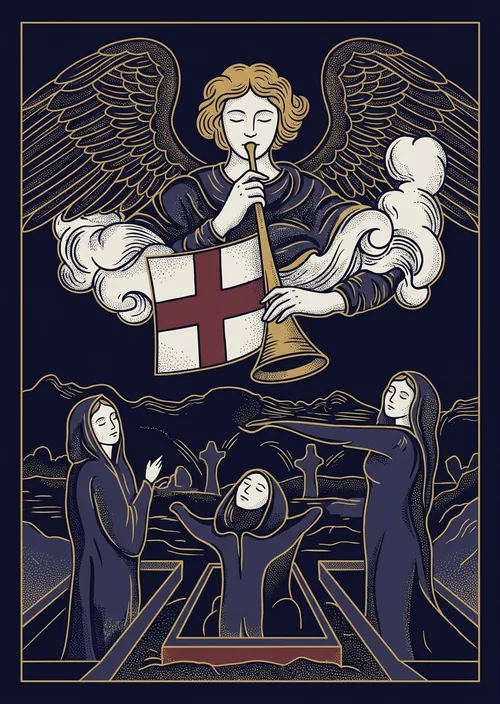
What the image shows
An angel sounds a trumpet from the clouds, and below, figures rise from open coffins on a grey sea with their arms lifted. In most decks a small banner with a cross hangs from the trumpet, and the risen figures are drawn as a family group: a man, a woman and a child. Nobody in the picture is being dragged. They are standing up and turning towards the sound.
The scene is borrowed straight from Christian resurrection imagery, which the older decks made no attempt to disguise. Modern readings keep the shape of it and drop the theology. What survives is the structure: everything that happened is now visible at once, and a response is required.
Upright and reversed
Upright, the meaning given is a summing-up, and a decision made in light of it. Reckoning, awakening and calling are the keywords. The card tends to come up when a long stretch of something is being assessed as a whole rather than day by day: a career reviewed, a relationship totalled up, a habit finally seen from the outside. The calling sense is the second half of it. The tradition holds that this kind of review produces a summons of some kind, and that hearing it and acting on it are separate steps.
Reversed, two readings compete and they are near opposites. One is refusing the summons: the reckoning has happened, the conclusion is known, and nothing is being done with it. The other is applying the verdict far too harshly to yourself, taking a fair assessment and running it as a prosecution. The rest of the spread usually settles it. Cards of stalling and delay around it favour the first, cards of self doubt and criticism the second, and a reader who picks one without looking is guessing.
Position in the trumps, and its correspondence
Judgement is the twentieth trump, sitting between the Sun and the World. That placement carries much of the weight. The Sun is uncomplicated clarity, Judgement is what you do with what has become clear, and the World, which closes the sequence, is completion. Read in order they describe seeing plainly, then choosing, then arriving. Taking Judgement as an ending in itself misses that it is the last card before the end and not the end.
Modern decks assign Pluto, with water as the element. Older schemes gave the card the element fire, and the planetary attribution was added in the twentieth century once the outer planets were folded into the Golden Dawn system. Pluto was matched to it for the obvious thematic reason, being the body associated with what is buried coming back up.
What the card asks
The site's position is that a reading is a way of putting a question to yourself, not a source of information about the future, and Judgement puts one of the sharpest. If you added up the whole of this period honestly, without the version you tell other people, what would the total say, and what would it ask you to do?
The card gives no guarantee that the answer is pleasant, and it makes no claim about how anything turns out. Its difficulty is that it does not allow the review to stay theoretical. A summing-up that changes nothing is precisely what the reversed reading describes.
Questions people ask about this
What does the Judgement card mean?
It describes a summing-up of a long stretch of something and a decision taken in light of it. Reckoning, awakening and calling are its keywords, and the tradition treats hearing the call and acting on it as separate steps.
Is Judgement about being judged by someone else?
Not in most modern readings. The assessment in the card is one the querent carries out on their own history. The imagery is borrowed from resurrection scenes, but the reading kept the structure rather than the theology.
What does Judgement mean reversed?
Either a reckoning refused, where the conclusion is known and nothing follows from it, or a verdict applied far too harshly to yourself. Cards of delay nearby favour the first reading, cards of self doubt the second.
Which planet rules Judgement?
Modern decks give Pluto, with water as the element, though older schemes attached the card to fire. The planetary assignment is a twentieth century addition to the Golden Dawn correspondences rather than an old tradition.
Why does the World come after Judgement?
Because Judgement is a decision and not an arrival. The Sun clarifies, Judgement chooses, and the World completes. Reading Judgement as the end of the story is the most common mistake made with it.
Does Judgement predict a big life change?
This site makes no predictive claims. The card is a prompt to total something up honestly and ask what the total requires, which is a question you can actually work on rather than wait for.