What the image shows
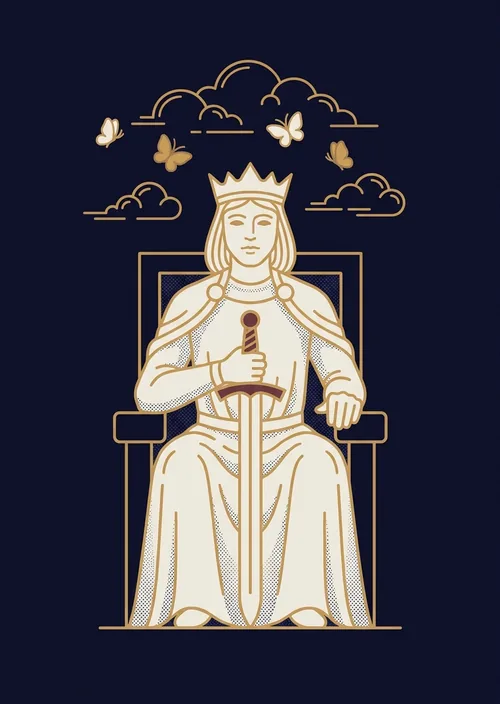
He sits facing forward on a stone throne carved with butterflies and a crescent, holding a single upright sword in his right hand. The blade leans very slightly to one side rather than standing perfectly vertical. Behind him the sky is pale and a line of trees bends in a wind that has not reached him.
The tilt of the sword is the detail readers return to, since a perfectly upright blade would suggest certainty and this one does not quite claim it. The butterflies on the throne belong to the suit's association with mind and transformation of thought. The moving trees put weather in the picture without putting any of it on the figure, which is read as a mind that stays in the same shape while conditions change around it.
Upright and reversed
Upright, the reading is decisions made on the merits. Authority, logic and truth are the attached words, and the card describes a standard rather than a temperament. What it praises is the ability to reach the same conclusion whether or not the answer is convenient, and to say the conclusion out loud afterwards. Readers often place this figure in professional or legal settings for that reason, though the card is not limited to them.
Reversed, the reading is logic used to avoid the human part of the question, and the reversed keywords cover a range. Rigidity is a principle held past the point where it fits the case. Cold reasoning is the argument being technically correct and unusable. Abuse of power is the harsher end, where the authority is real and is being pointed at somebody. These call for very different responses, and what separates them is whether the neighbouring cards show a person on the receiving end.
Kings, and the suit of air
Each suit closes with four court cards, and the convention most modern readers follow gives the king the outward application of the element. The queen holds it inwardly, the knight drives it too hard, the page is still learning it. The king is the element put to work, and what that produces depends entirely on which element it is.
Air in the tradition is thought, speech, conflict and the framing of a problem. Applied outwardly it becomes judgement, argument and the setting of terms, which is why this court card carries more institutional weight than the other three kings. The data used here gives air as the element and no zodiacal correspondence, so rank and suit do the work. Readers who treat the courts as manners of acting rather than as people find this one especially easy to recognise in themselves.
The question it puts
The question is whether the clarity you are applying is serving the decision or protecting you from it. Reasoning is the most respectable place to hide, because nobody challenges it and it looks like work. A conclusion reached without favour is worth a great deal, and a conclusion reached without regard for who it lands on is a different object entirely.
This site reads a tarot card as a structured prompt for thinking rather than as information about the future. The card does not tell you whether your judgement is correct. It asks what you have left out of it, and whether the omission was a method or a convenience.
Questions people ask about this
What does the King of Swords mean upright?
Decisions made on the merits. Authority, logic and truth are the associated words, and the card describes a standard of judgement rather than a personality. Reaching an inconvenient conclusion and stating it is the core of it.
What does the King of Swords mean reversed?
Logic used to avoid the human part of the question. That covers rigidity, reasoning that is correct but unusable, and at the harsher end authority pointed at somebody. Context separates them.
Why is the sword not perfectly upright?
The slight tilt is often read as the picture declining to claim total certainty. A vertical blade would suggest a settled verdict, and the card is usually taken as the method of judging rather than the verdict.
How does he differ from the Queen of Swords?
The usual convention is that the queen holds air inwardly and the king applies it outwardly. Both are read as clear sighted, so the difference lies in whether the clarity stays private or sets terms for others.
Does the King of Swords mean a real person?
It can, and it can equally describe a way of acting. Readers often place him in legal or professional settings, though nothing in the card requires that. The question asked usually settles which reading fits.
Does this card have an astrological correspondence?
Not in the data used on this site. It carries air as its element with no sign or planet attached, so the meaning comes from the element and from the king's place among the court cards.