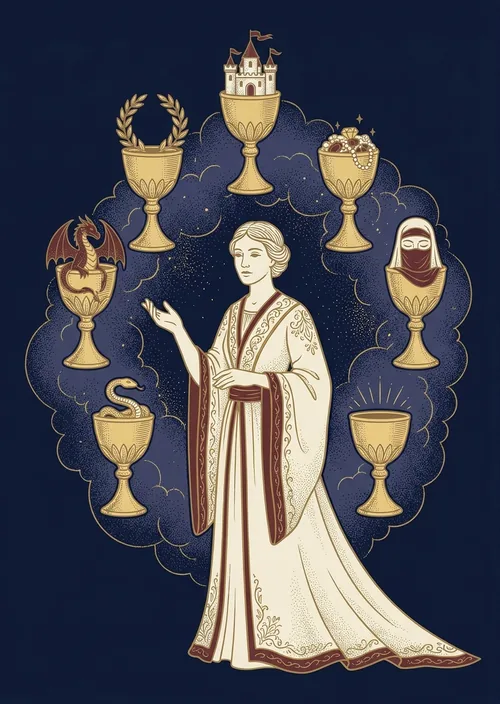
What the image shows
The cups carry a head, a veiled glowing figure, a snake, a castle, jewels, a wreath and a dragon. They sit on cloud rather than on any surface, and the figure looking at them is drawn as a dark outline with no features, which readers usually take as the viewer standing in for themselves.
The contents are deliberately mixed in kind. Some are plainly good, some are plainly not, and at least one is ambiguous depending on the deck. The wreath in several versions has a skull marked faintly on the cup beneath it. The tradition reads the arrangement as an argument that appeal and value are different things, and that a display like this makes them hard to tell apart.
Upright and reversed
Upright, the reading is options that are mostly imagined rather than available. Choice, fantasy and possibility are the words attached to it, and the tradition does not treat the imagining as worthless. What it warns against is mistaking the survey for the decision. Someone in this card can spend a long time genuinely enjoying the array and end with nothing chosen.
Reversed, two readings compete and they are close to opposites. The first is clarity: the cloud thins, the unreal options drop away, and one real choice is left. The second is being paralysed by the array, or picking badly out of fatigue with it. What separates them is whether the surrounding cards suggest a decision has become possible or merely urgent, and the card itself does not settle it.
Sevens, and the suit of water
The numbered minors are read as a number in an element, and the sevens all complicate whatever the sixes delivered. In fire the complication is defence, in air an indirect route, in earth a wait. The seven is the point where a thing gained has to be tested against reality, and the test is different in each suit.
Cups carry water, which the tradition reads as feeling, attachment and what you want. A seven in water is therefore a complication made of wanting, which is exactly what a field of appealing but insubstantial options is. There is no astrological correspondence attached to the card in the data used here, so the number and the element supply the whole reading.
The question it puts
The question this card puts is which of the options in front of you you could actually start on this week, and what would have to be true for the others to become real. The list usually shortens fast under that test, and that shortening is the useful part.
This site treats a reading as a structured way of asking yourself something rather than a source of information about the future. Nothing here tells you which cup to take. The card makes the point that not all seven are cups you can reach, which is a claim you can check without any help from a deck.
Questions people ask about this
What does the Seven of Cups mean upright?
Options that are mostly imagined rather than genuinely available. The tradition does not condemn the imagining, but it warns against mistaking a survey of possibilities for a decision.
What does the Seven of Cups mean reversed?
Two readings compete. One is clarity, where the unreal options fall away and a real choice remains. The other is paralysis, or a poor choice made out of fatigue. The surrounding cards decide.
What is in the seven cups?
A head, a veiled figure, a snake, a castle, jewels, a wreath and a dragon. The mixture of plainly good and plainly bad contents is the point: appeal and value are not the same thing.
Is this card about daydreaming?
In part. The tradition treats imagined possibility as real activity, not as idleness, but it also reads the card as a state that can continue indefinitely without producing a choice.
Does the Seven of Cups have an astrological ruler?
Not in the card data used on this site, which gives water as its element and no zodiacal or planetary correspondence. Number and suit carry the meaning between them.
How does it differ from the Two of Cups or other choices?
This card is about the array rather than about any option in it. Cards that describe an actual decision, such as the Lovers, put a choice in front of the reader that can be made.