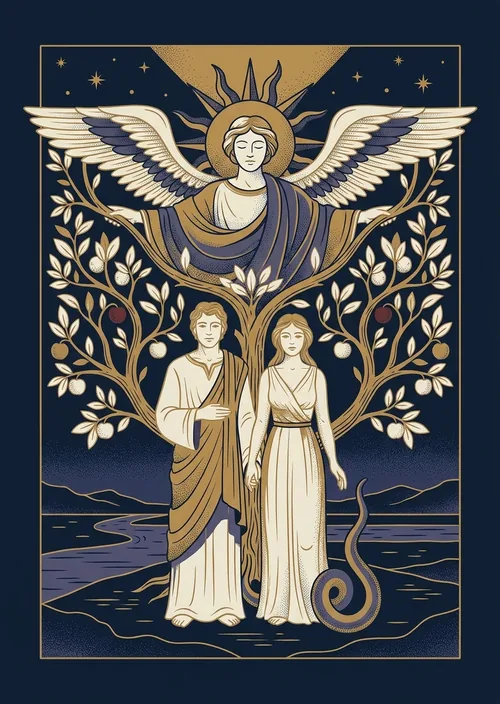
What the image shows
Two figures stand apart under a winged figure above them, with a tree behind each of them and a bright sky between. The composition is deliberately not a wedding picture. The figures are separate, they are looking at each other rather than at the viewer, and the presiding figure above is doing the blessing rather than the joining.
Older decks make the point more bluntly by showing a young man between two women with a figure aiming an arrow overhead, an image of a decision rather than a marriage. Both versions carry the same reading. Something is being chosen, out loud, and the choosing is the subject of the card.
Upright and reversed
Upright, the standard reading is a choice that decides what you are rather than merely what you do. Its keywords are choice, union and values, and the third one governs the other two. A union that appears in this card is read as an agreement about what matters, not simply an attraction. That is why the tradition is comfortable putting the card in a spread about work or a move, where no romance is involved at all.
Reversed, two readings compete and they are not the same complaint. One is a decision postponed, where the reader keeps the options alive because closing one is uncomfortable. The other is a partnership in which the stated values do not actually meet, a misalignment that the surface of the thing hides. What decides between them is whether the other cards describe a situation still open or one already entered. A reader who picks between them without looking is guessing.
Where it sits and what rules it
The Lovers is the sixth trump, after the Hierophant and before the Chariot. That order is worth reading as a sentence. The Hierophant is the card of inherited rules and received teaching. The Lovers is where you decide for yourself which of those you keep. The Chariot, which follows, is the card of moving in one direction, and a direction is exactly what a decision produces.
The correspondence attached to the card is Gemini, an air sign, in the scheme the Golden Dawn set out and most modern decks inherited. That is a nineteenth century arrangement rather than an ancient one, but it fits the card unusually well. Gemini is the sign of two of something and of the mind that can hold both at once, which is a fair description of the moment before a choice closes.
The question it puts
The honest use of this card is as a prompt. It asks what you would have to be true about yourself for the choice in front of you to make sense, and whether you can say that out loud. A choice you cannot state your reasons for is usually a choice you have not made yet.
This site takes the view that a reading is a structured way of asking yourself something rather than information about what is coming. The Lovers does not tell you which option to take, and nobody should tell you it does. It tells you the decision is about values, and that reframing is the whole of what it offers.
Questions people ask about this
Is The Lovers a card about romance?
Not primarily. Romance is one setting in which the card appears, but the tradition reads it as a choice that commits you to a set of values. It sits comfortably in a spread about work or a move where no relationship is involved.
What does The Lovers mean reversed?
Two readings compete. One is a decision being postponed because closing an option is uncomfortable. The other is a partnership where the stated values do not actually meet. The surrounding cards decide which applies.
Which sign is The Lovers linked to?
Gemini, an air sign, in the correspondence the Golden Dawn set out in the nineteenth century and most modern decks still use. It is a modern scheme rather than an ancient one.
Does The Lovers mean I have met the right person?
No, and this site makes no claim of that kind. The card describes a choice and the values it rests on, which is something you can examine yourself rather than something a card can know.
Why does the Chariot follow The Lovers?
The trumps run in a deliberate order. A choice produces a direction, and the Chariot is the card of moving in one. Reading the pair in sequence usually says more than reading either alone.
Can I draw this card in a reading here?
Yes. Every spread on the site draws from the full deck, with reversals included if you leave them switched on, and each reading rebuilds from its own link.