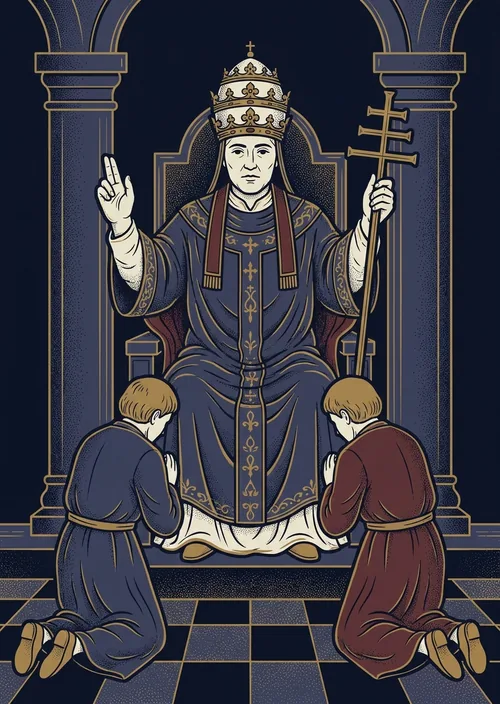
What the image shows
A robed figure sits between two stone pillars, wearing a triple crown and raising one hand in blessing. Crossed keys lie at his feet and two tonsured acolytes stand below him, receiving rather than speaking. Almost every element in the picture is about transmission. The keys are handed on, the gesture is one taught to be repeated, and the pillars are architecture, meaning something built by people who came before and left standing.
The tradition reads the card as the institution rather than the individual. Where the Emperor before him rules by decision, the Hierophant carries something he did not invent and is not free to change. That distinction is worth holding on to, because it is what separates the card from a simple picture of power.
Upright and reversed
Upright, the meaning given in most modern decks is the established way, and the good reasons it became established. Its keywords are tradition, teaching and institutions. The card comes up around apprenticeship, formal study, marriage, religious practice, professional bodies, and any situation where the answer already exists and someone can teach it to you. Read generously, it is the card that says you are not the first person to face this.
Reversed, the accepted readings pull in two directions. One is convention followed without belief, the hollow ritual that continues because stopping would be awkward. The other is convention rejected without examination, the refusal that has not troubled to find out why the rule exists. Both are failures of the same relationship, which is why the same card carries them. What decides between them in a spread is usually the querent's own position: the cards around a person already inside the institution tend to point at the first reading, and those around someone outside it at the second.
Its place in the sequence, and its sign
The Hierophant is the fifth trump, following the Emperor and preceding the Lovers. That ordering does a lot of work. The Emperor is structure imposed, the Hierophant is structure inherited, and the Lovers, which comes next, is traditionally read as the first card in which a genuine personal choice is made. Reading the three in order gives you a sequence about being placed inside rules and then having to choose within them.
The correspondence is Taurus, and the element earth. That assignment comes from the Golden Dawn scheme of the late nineteenth century, which most modern decks adopted and which is now so standard that it is often mistaken for medieval. Taurus fits the card by temperament rather than by anything astronomical: fixed, slow to move, attached to what has proved durable.
What it asks you
This site takes the view that a tarot reading is a structured prompt for thinking, not information about what is going to happen. On that basis, the Hierophant puts a fairly precise question. Where in the situation are you following a rule you have never actually examined, and would you keep it if you did examine it?
That question cuts in both directions, which is the point. It is as awkward for someone who has walked out of every institution they joined as for someone who has never questioned one. The card does not tell you which answer to reach, and a reader who uses it to recommend obedience or rebellion has added something that is not in the card.
Questions people ask about this
What does The Hierophant mean in a reading?
It stands for the established way of doing something and the reasons that way became established. Tradition, teaching and institutions are its usual keywords, and it often appears around study, formal commitments and situations where a tested answer already exists.
Is The Hierophant a negative card?
The tradition does not read it that way. It describes inherited structure, which can be a support or a constraint depending on the situation. The surrounding cards and the question asked decide which side of that the reading emphasises.
What does The Hierophant mean reversed?
Two readings are both accepted. One is convention followed without belief, ritual kept up out of habit. The other is convention rejected without examination. Whether the querent is inside or outside the institution in question usually decides which fits.
Why is The Hierophant linked to Taurus?
The link comes from the Golden Dawn correspondences that most modern decks use, not from anything ancient or astronomical. Taurus was matched to the card for temperament: fixed, patient and attached to what has already proved durable.
How does it differ from The Emperor?
The Emperor rules by his own decision and can change his mind. The Hierophant carries something he did not invent and cannot simply revise. One card is authority exercised, the other is authority transmitted.
Does the card mean I should follow the rules?
No. It raises the question rather than answering it. The useful reading is to ask which rule in the situation you have never examined, and whether you would keep it if you did.