What the image shows
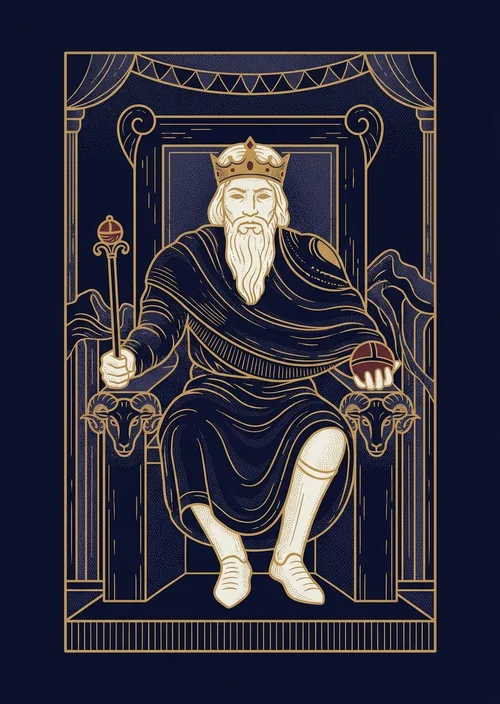
A figure sits on a stone throne set with rams' heads, holding a sceptre, with bare mountains behind him and a thin river at their foot. The stone is the point. Nothing in the picture is soft, and nothing in it is growing. The tradition reads the throne as a position held rather than a place rested in, and the armour under the robe as a reminder that the authority was won and is still being defended.
The rams tie the card to Aries, and the mountains to a landscape that will not yield to wishing. The one living element is the water, small and off to the side. Readers who like the card and readers who distrust it usually agree on the description and disagree only about whether that much stone is a good thing here.
Upright and reversed
Upright, the meaning is structure imposed on a situation that needed it. The keywords are structure, authority and order. It is worth noticing that the card does not say the structure is kind or that the person imposing it is right. It says a shape has been put on something formless, and that this was the thing the situation lacked. In a question about a project drifting or a household with no rules, it reads as relief.
Reversed, two readings compete and they point in opposite directions. One is rules held long past their usefulness, which shows as rigidity or domination, an authority that has stopped listening. The other is the absence of any structure at all, weak boundaries, nobody willing to decide. What decides between them is the question you asked and the cards around it. If the spread already shows control and pressure, the reversal usually reads as too much. If it shows drift, it reads as too little. A reader who picks one without looking is guessing.
Where it sits in the trumps
The Emperor is the fourth trump, directly after the Empress and directly before the Hierophant. That position does most of the work. The Empress is fertile, generative and unbounded. The Emperor is what gives that output an edge and a rule. Read as a pair they are less about gender than about growth and limit, and each is weak without the other.
The Hierophant, which follows, takes the Emperor's private authority and makes it institutional, a rule that outlives the person enforcing it. Reading the three in order gives a sequence of production, containment and tradition, and it tells you where an Emperor left alone tends to end up.
Fire, Aries, and the question it puts
The element is fire and the sign is Aries, in the correspondence set out by the Golden Dawn in the late nineteenth century and carried into most modern decks. That is a recent system rather than an ancient one, but it is the one your deck almost certainly uses. Aries brings initiative and a willingness to go first, which explains why this card reads as authority taken rather than granted.
The honest paragraph is this. A reading is a structured way of putting a question to yourself, not information about what will happen. The Emperor asks where you are the one holding the shape, and whether the rule you are enforcing is still doing the job it was made for. That is answerable without believing a card knows anything.
Questions people ask about this
What does The Emperor mean in a reading?
Structure imposed on a situation that needed it. The keywords are structure, authority and order. The card does not claim the authority is kind, only that a shape has been put on something that had none.
Is The Emperor reversed a negative card?
It is difficult rather than negative, and it has two accepted readings. Either rules are being held past their usefulness, or there are no rules at all. The rest of the spread and the question you asked decide which.
Which sign rules The Emperor?
Aries, with fire as the element, under the Golden Dawn correspondences used by most modern decks. The rams' heads on the throne are the visual marker of that link.
How does The Emperor relate to The Empress?
They sit next to each other in the trumps and are usually read as a pair. The Empress generates without limit and the Emperor sets the limit. Each reads as incomplete when the other is missing from the picture.
Does The Emperor mean a particular person?
Some readers take it as a father, a boss or an authority figure in your life. Others read it as a stance you are taking yourself. Neither is more correct, and the surrounding cards usually make it obvious which fits.
Can I draw The Emperor here?
Yes. Every reading on the site draws from the full deck, with reversals included unless you turn them off, and each result rebuilds from its own link so you can return to it later.