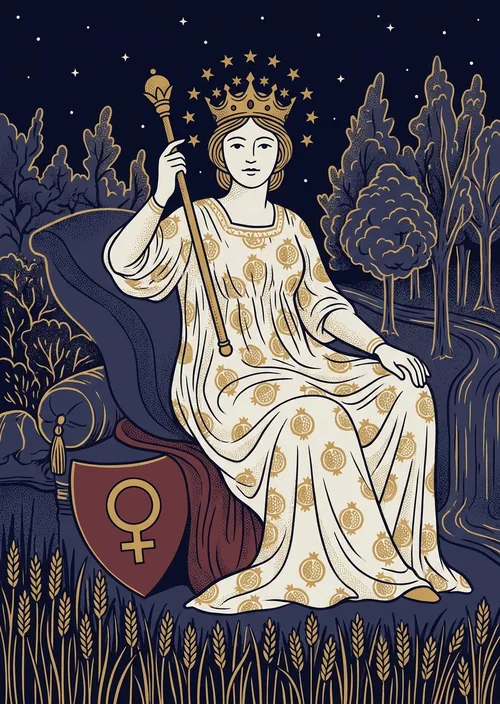
What the image shows
She is seated rather than enthroned upright, on cushions, in a field of ripe wheat with a stream running behind her. The shield beside her carries the sign of Venus. Nothing in the picture is being made or decided. The wheat grew on its own schedule and she is sitting in it.
That stillness is the point the tradition keeps returning to. The Empress is not the card of effort. She is the card of the conditions that make effort pay off, which is why she is read for pregnancies, gardens, long projects and anything else where the useful contribution is warmth and patience rather than pressure. Read her as the difference between planting and pulling at the stem.
Upright and reversed
Upright the reading is that something is being nourished and is growing at its own pace. The keywords are abundance, care and growth. The phrase to hold on to is its own pace, because the card carries no claim about speed and often turns up when someone wants a thing to be further along than it is.
Reversed the tradition splits in two, and the split is worth naming rather than resolving. One reading is care that has become control: too much attention, checked too often, growth prevented by handling. The other is neglect, a project or a person left to fend for itself far too early. Both are failures of the same relationship. The surrounding cards usually decide which, and so does the plain question of whether the querent has been hovering or absent.
Her place in the trumps
She is the third trump, between the High Priestess and the Emperor, and that sandwich carries a lot. The High Priestess holds something back and says nothing. The Emperor after her imposes structure from outside. The Empress between them is the only one of the three who lets a thing develop on terms that are not hers.
Her element is earth and her planet is Venus in the correspondence set out by the Golden Dawn, which most modern decks inherited. That is a nineteenth century scheme rather than an ancient one, and it is worth saying so. Venus here is not romance so much as attraction and value, the reason something is worth tending at all.
Earth, in the same scheme, is the element of bodies, soil, money and slow material change. Put together they describe a card that is interested in what actually thickens and fills out over time rather than in what is felt or decided.
The question she puts
A reading is a structured prompt for thinking, not a report on what is coming, and the Empress puts an unusually practical question. Something in your life is growing slowly. Are you feeding it, or are you checking on it so often that you are the reason it is not further along.
The uncomfortable version is the reverse. If a thing you care about has been left alone for months while you told yourself it was developing, the card asks you to look at it honestly rather than to be reassured. She does not promise a harvest, and no card can.
Neither version of that question needs the card to be right about anything. The Empress is useful because she names a relationship most people hold badly in one direction or the other, and because she gives you a way of asking which direction is yours. That is the whole of what the tradition offers here, and it is enough to be going on with.
Questions people ask about this
What does the Empress mean in a reading?
That something is being nourished and is growing at the pace it needs. The card is read for anything that develops rather than gets built, and it makes no claim about how fast.
Does the Empress mean pregnancy?
It is one traditional reading among several, and it should not be treated as an announcement. The card describes a condition of growth, and pregnancy is the most literal example rather than the intended one.
What does the Empress reversed mean?
Either care that has tipped into control, or something abandoned to look after itself too early. Which of the two applies is decided by the rest of the spread and by what the querent already knows about their own habits.
Which planet rules the Empress?
Venus, with earth as the element, in the Golden Dawn correspondences that most modern decks follow. Venus in this context means attraction and worth rather than romance specifically.
How does she differ from the Emperor?
The Emperor imposes a structure and holds it. The Empress creates conditions and then waits. They sit next to each other in the trump sequence precisely because the contrast is the lesson.
Can I draw the Empress on this site?
Yes. Every spread here draws from the whole deck, with reversals included unless you turn them off, and each reading rebuilds from its own link so you can return to it later.