What the card shows
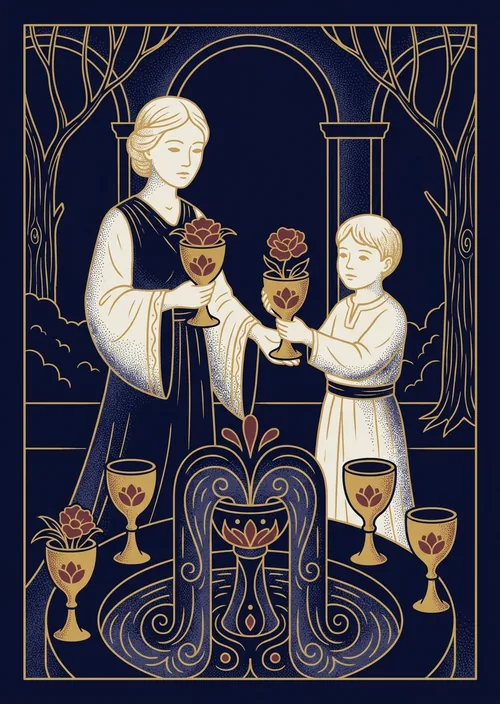
In a walled courtyard, a child hands a cup filled with white flowers to a smaller child. Four more flowering cups stand on the ground and one on a pedestal behind them. A figure who might be a guard walks away in the background, and the buildings are old and solid. Everything in the frame is enclosed and safe, and the exchange at the centre of it is a gift given for no reason.
The tradition reads the setting as much as the figures. This is a place with walls around it, and the walls are why the memory feels good. Whether that is a shelter or an enclosure is precisely what the card leaves open.
Upright and reversed
Upright, the meaning given is the past reaching pleasantly into the present, with nostalgia, childhood and kindness as its keywords. It turns up around old friendships resuming, family, returning to a place you knew, and small unearned generosities. The kindness sense is worth keeping separate from the nostalgia one: some readers take the whole card as an act of simple goodwill with no reference to the past at all.
Reversed, the standard reading is a memory kept better than it was and used as an escape, with living in the past among its keywords. There is a second and quite different reversed sense, letting go, in which the hold of the past finally loosens. These are close to opposites and the surrounding cards have to decide. Cards of stagnation nearby favour the escapist reading, cards of movement favour release. The one thing the reversal consistently indicates is that the relationship with the past has become active rather than incidental.
Six-ness, and the suit of water
Every six in the deck answers its own five. The Five of Cups is the figure standing over spilled vessels and failing to notice the ones still upright, so the loss in this suit is emotional and the recovery has to be emotional too. Six restores a balance, and in cups the balance comes back through something remembered rather than through anything new.
Cups is the suit of water: feeling, attachment, memory, the inner life. That is why this six looks backwards while the Six of Swords looks forwards and the Six of Pentacles looks sideways at another person. The number supplies the settling, the suit supplies the direction. In the Golden Dawn scheme that modern decks follow, the minor cards carry the element of their suit without an attached sign, so water is the whole of the correspondence here.
What it asks you
Readings on this site are prompts for thought, not statements about what is coming. The question this card puts is whether the version of the past you are drawing on is the one that actually happened, and what you are using it for now.
That is a harder question than the card's soft imagery suggests. A remembered good period can be a genuine resource, and it can also be a reason to refuse the present. The card does not distinguish between them for you, and a reader who turns it into simple reassurance has taken the difficulty out of it.
Questions people ask about this
What does the Six of Cups mean?
It describes the past reaching pleasantly into the present. Nostalgia, childhood and kindness are its keywords, and it often appears around old friendships, family, familiar places and small unearned generosities.
What does the Six of Cups mean reversed?
Most often a memory kept better than it was and used to avoid the present. A second accepted reading is letting go of the past's hold. Nearby cards of stagnation favour the first, cards of movement the second.
Is the Six of Cups about children?
The image shows children and the card is often read as childhood, but the reading is about the past reaching into the present rather than about actual children. Some readers take it simply as an act of goodwill.
What does six mean across the suits?
Six answers the difficulty of the five and restores a balance in whatever terms the suit understands. Cups resolves emotional loss through memory, which is why this six looks backwards where the others do not.
What element is the Six of Cups?
Water, the element of the cups suit in the correspondences used by most modern decks. Minor cards in that scheme carry a suit element but no zodiac sign of their own.
Is nostalgia treated as a good thing here?
The tradition treats it as neither. A remembered good period can be a real resource or a reason to refuse the present, and the card is designed to make you check which one you are doing.