What the image shows
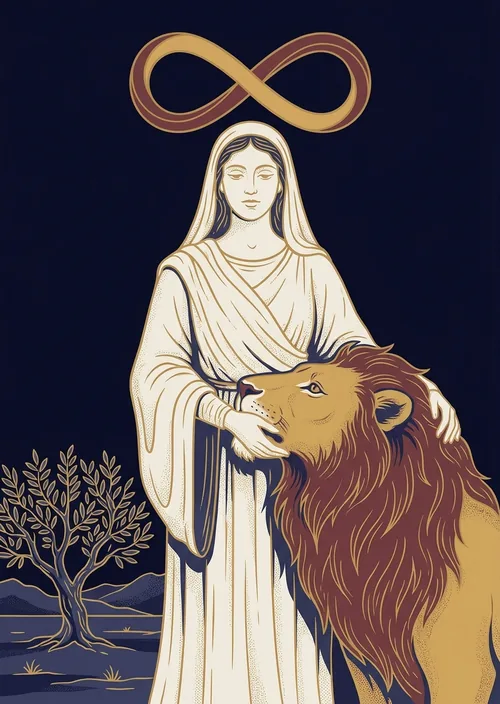
A woman in a white dress stands beside a lion and closes its jaws with her bare hands. She is not braced and the lion is not fighting her. A garland of flowers runs around her waist and the same sideways figure of eight from the Magician sits above her head.
The reading follows from the posture rather than the act. A person overpowering an animal would be drawn tensed. This one is drawn calm, and the tradition takes that calm as the whole point. The lion is generally read as appetite, temper or drive, which is something to be handled rather than killed.
The white dress and the flowers are read the same way, as the absence of armour. Whatever is being managed here is not being fought at a distance. The card puts the person and the animal in contact.
Upright and reversed
Upright, the keywords are patience, courage and restraint, and courage sits in the middle of them for a reason. The card does not describe someone who feels nothing. It describes someone who feels the pull and does not act on it immediately, which is a form of nerve rather than an absence of one.
Reversed, the tradition offers two readings that point in opposite directions. The first is forcing what needed patience, where the hands close too hard and the situation is pushed rather than steadied. The second is doubting a strength you demonstrably have, which shows up as exhaustion and deferral. What separates them is where the pressure in the spread is coming from. Cards about other people or about deadlines tend to support the forcing reading. Cards about the querent's own state tend to support the self-doubt one.
Where it sits in the sequence
In the ordering this deck uses, Strength is the eighth trump, following the Chariot and preceding the Hermit. That is a legible run. The Chariot is control asserted outwardly and visibly, Strength is control that no longer needs to be visible, and the Hermit withdraws from the question of control altogether.
It is worth knowing that older decks number Strength eleven and Justice eight, and that the swap is a Golden Dawn adjustment made to fit the zodiac. Neither ordering is wrong. Readers simply need to know which one their deck is using before they read the neighbouring cards.
Either way the run makes a legible argument about control, and the card in the middle is the one where control stops looking like effort. That is the reading most decks are built to support.
Leo, fire and the question it puts
The element is fire and the sign is Leo, both from the same late nineteenth century correspondence that most modern decks carry. Leo is the lion, which makes this one of the tidier attributions in the deck, and the fire element accounts for the drive being managed rather than removed. The tradition does not read this card as coldness.
Used honestly, a Strength pull is a prompt rather than a forecast. The question it puts is which pressure you are currently meeting with volume when meeting it quietly would work better, and whether the quiet version is available to you today. That is answerable without any claim about what happens next.
There is a second question worth putting beside the first. If the quiet version is not available today, what would make it available, since the tradition treats this as a capacity that is trained rather than owned.
Questions people ask about this
Is Strength card number eight or eleven?
Both numberings exist. This deck follows the Golden Dawn ordering where Strength is eight and Justice is eleven. Older decks reverse the two. Check your deck before reading the neighbouring trumps.
What does Strength mean reversed?
Two readings compete. One is forcing something that needed patience, the other is doubting a strength you actually have. The rest of the spread decides which, and the two call for different responses.
What does the lion stand for?
The tradition reads it as appetite, temper or drive. The card shows it handled rather than destroyed, which is why restraint rather than suppression is the usual reading.
Which sign is attached to Strength?
Leo, with fire as the element, in the correspondence used by the Golden Dawn and most modern decks. The lion in the picture makes it one of the more obvious attributions.
Is Strength about physical courage?
Not usually. The figure is not straining, and the tradition reads the card as composure under pressure. Physical courage is not excluded, but it is not what the image is built to show.
What question should I ask when it comes up?
A useful one is where you are currently applying volume instead of patience. This site treats a reading as a structured prompt rather than information about the future, and that question can be answered honestly.