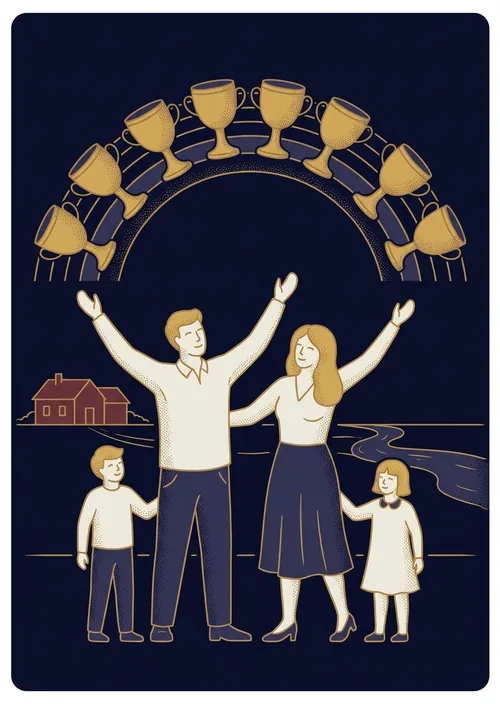
The rainbow over the house
A couple stand with their arms raised, two children playing beside them, a house and a river behind. Ten cups arc overhead in a rainbow. Nobody in the picture is looking at the cups.
That last detail carries the reading. The cups are above the scene rather than in anyone's hands, which the tradition takes as the emotional life of the household being ambient rather than held. The figures have their backs partly to us and are turned towards the view. It is a domestic image and it is deliberately generic, which is exactly why the reversal works. This is the standard picture of a good life, and standard pictures are the ones people measure themselves against.
Tens and the suit of water
Ten is where a suit reaches its limit, and each suit ends differently. Wands end in a load too heavy to see over, swords end in a conclusion with nothing left to argue, pentacles end in wealth that has become inheritance. The number itself does not decide whether the ending is welcome.
Cups are water, the suit of feeling and attachment. Feeling taken to completion is not intensity, it is settlement, and settlement is quiet. That is why the Ten of Cups reads as domestic rather than romantic. The Two of Cups is the meeting, the Three is the circle, and by the ten the feeling has become a household with a roof over it. Minor cards carry no sign in the data used here, though the Golden Dawn assigned decans to the pips and several modern decks print them.
Upright and reversed
Upright, the reading is emotional completeness, usually domestic. Fulfilment, family and harmony are the keywords. The tradition does not treat this as excitement, and readers who expect a peak experience from it are reading the wrong card. What it describes is the version of happiness that does not require anything further to happen.
Reversed, the standard reading is a picture that looks right and does not feel it. Strained family, misaligned dream and surface calm are the keywords, and they point at slightly different faults. One is a household under real pressure. Another is the arrangement being someone else's idea of a good life rather than yours, which is a harder reversal to see because nothing in it is wrong. What tends to decide between them is whether the surrounding cards show conflict or show nothing at all. Conflict points at strain. A quiet spread points at the borrowed dream.
The question the card puts
A reading is a prompt for thinking here, not a claim about what is coming. The question this card puts is a plain one. Whose picture of a settled life are you working towards, and when did you last check that it is still yours.
Upright the question is gentler and still worth asking. If nothing further needed to happen, would that be a relief or a loss. People answer that one quickly, and the speed of the answer usually says more than the card.
Questions people ask about this
What does the Ten of Cups mean?
Emotional completeness, most often in a domestic setting. The tradition reads it as settlement rather than excitement, describing the state where nothing further needs to happen for the situation to be good.
What does the Ten of Cups mean reversed?
A picture that looks right and does not feel it. That covers both a household under strain and a life shaped by somebody else's idea of happiness. A spread showing conflict points at the first, a quiet one at the second.
Is the Ten of Cups about marriage?
It is often read that way, but the image is a household rather than a wedding. The card describes a settled emotional life in general, which need not involve a couple at all.
How does it differ from the Two of Cups?
The two is contact between two people, immediate and unsettled. The ten is what that becomes after years, with a house and children in the frame. Same suit, opposite ends of it.
What element does it belong to?
Water, as a cups card. Water is assigned to feeling and attachment, so the ten shows feeling at its full extent, which the tradition takes to be quiet rather than intense.
Can I draw this card here?
Yes. All the spreads on the site draw from the full deck, reversals included if you leave them on, and every reading rebuilds from its own link so you can return to it later.