Under the archway
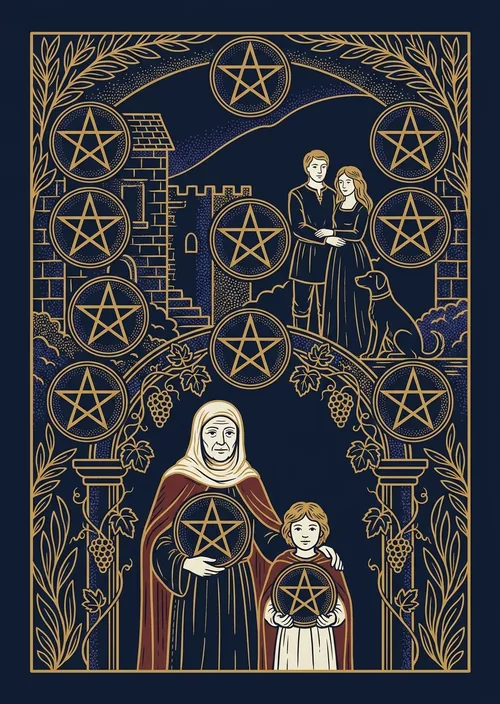
An old man in a long patterned robe sits at the right of the frame with two white dogs at his hands. Beyond him a man and a woman stand talking, and a child holds on to the woman's dress while reaching towards one of the dogs. An archway carries a coat of arms, and behind it the buildings of a settled estate are visible. Ten coins are placed across the whole picture in the arrangement of the Tree of Life.
Nobody in the scene is interacting with the old man, and readers make a lot of that. He is inside the arrangement and no longer at the centre of it. The dogs know him, the family is talking to each other, and the property continues around all of them. The card shows a structure working without needing the attention of the person who set it up.
Upright and reversed
Upright, this is legacy, family wealth and stability, and the specific quality is duration. Not comfort now, but arrangements likely to be intact in twenty years. Property, inheritance, a business that will outlive its founder, a household that holds together through changes of membership. The tradition treats it as one of the most straightforwardly good cards in the deck, with the reservation that it is about material and structural security rather than happiness.
Reversed, the split follows the two halves of the picture. In one version the structure exists and is under threat, which the keyword family friction covers, along with disputes about money and inheritance that damage the relationships they run through. In the other the structure was never built at all, and short-term thinking is the reason. Loss belongs to both versions. Which applies is usually obvious to the querent, since one is about defending something and the other about having nothing to defend.
Ten, and the end of the earth suit
Ten is the last number in every suit, the point where the element has run all the way out. In wands it arrives as a load too heavy to carry, in swords as a definitive ending, in cups as emotional fulfilment. The number always means completion; what completion feels like depends entirely on the element.
Earth is money, the body, work and material security, and a completed version of that is the only one of the four that naturally extends past a single lifetime. Buildings, land and money can be handed on, and feelings and arguments cannot. That is why this card ends up meaning inheritance where the other tens end up meaning arrival. It carries earth and no zodiacal ruler in the data used here, so number and suit account for the whole of it.
The question the card puts
The question is unusually long-range for a single card. What are you currently building that will still stand once you are not maintaining it, and is anyone else able to maintain it. Most plans fail the second half rather than the first.
There is a harder version for people who draw it reversed. If nothing has been built, that is often a series of reasonable short-term choices rather than a failure of character, and the card does not moralise about it. A reading here is a prompt for thinking rather than information about the future, and this prompt is worth more than one week of attention.
Questions people ask about this
What does the Ten of Pentacles mean?
Security arranged to last. Legacy, family wealth and stability, with the emphasis on duration rather than comfort. Property, inheritance and households that survive changes of membership all fit.
What does the Ten of Pentacles reversed mean?
Either a structure under threat, with family friction and disputes over money, or a structure never built because of short-term thinking. Loss belongs to both readings.
Why is the old man being ignored?
Readers take it as the point of the picture. He is inside an arrangement that now runs without his attention, which is what distinguishes legacy from ownership in this card.
Does the card always mean family?
Not literally. It describes anything built to outlast its builder, including a business or an institution. The family scene is the tradition's clearest example rather than a restriction.
How does it differ from the Ten of Cups?
Both are completions. Cups completes as emotional fulfilment, which lives in the present; earth completes as something transferable, which is why this one reads as inheritance instead.
Is there an astrological correspondence?
None in the data used here. The card has earth as its element and no sign or planet, so its meaning comes from the number ten and from the suit it closes.