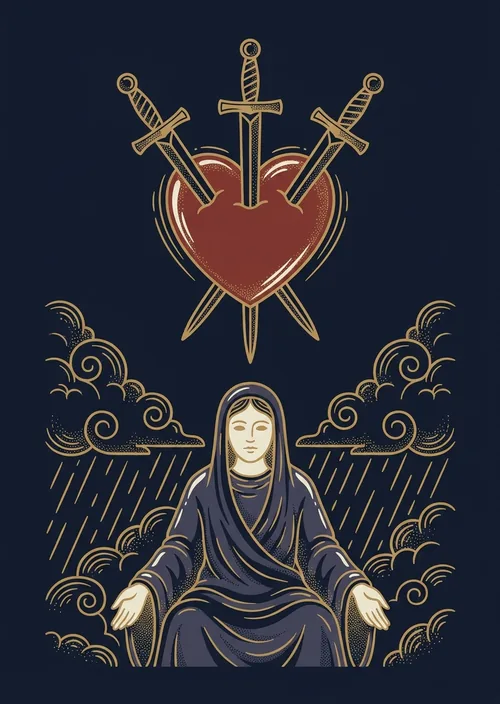
A heart, three swords, and rain
The image is almost a diagram. A red heart floats against a grey sky, pierced through by three straight swords arranged in a fan. Behind it there is heavy cloud and falling rain. There are no people, no landscape and nothing to interpret loosely.
That plainness is deliberate and it is why the card has the reputation it does. Most of the deck offers a scene you can read several ways. This one offers a wound and weather. Readers take the swords as the suit of thought and speech, which is what distinguishes this grief from the grief in the Five of Cups. The pain here came through words or through knowledge. Somebody said something, or something became impossible not to know, and the heart is where it landed.
Upright and reversed
Upright, the reading is heartbreak, grief and painful truth together. The last of those is the part readers most often drop. The card does not describe a misunderstanding or an unfair blow. It describes a hurt that came with a fact in it, which is exactly why it cannot be argued away. Honest practice says so plainly rather than promising the reader that it was all a mistake.
Reversed, the accepted readings pull against each other, and the tradition is comfortable with that. One is healing, the beginning of recovery, the swords being drawn out. The other is grief that is being held rather than released, sometimes as an old injury kept polished, sometimes as forgiveness that is being withheld on purpose. Position and neighbours settle it. A reversal late in a spread, after cards of movement, usually reads as healing. One sitting among cards of resentment or repetition reads as grief kept on.
Threes across the suits, and what air does to them
Numbers behave consistently across all four suits, and reading a pip means reading the number through the element. Threes are the first increase after a pair. Two is a meeting, and three is what that meeting produces, so threes usually cover growth, output and the widening of something. In Cups it is celebration, in Wands it is expansion, in Pentacles it is skilled work done with others.
Air is the suit of thought, language and judgement, and it is the element where increase is not welcome. More thinking about a hurt does not reduce it. What grows here is understanding, and understanding is precisely what makes the wound specific: you know what happened, you know who did it, and you know it was true. That is why this card reads sharper than a straightforward card of sadness. In the Golden Dawn tables the pips also carry a planet in a sign, though the deck data behind this page records the element alone.
The question it puts
Tarot is a prompt for thinking, not a source of information about the future, and a card like this earns nothing by being made gentle. The question it asks is whether the thing that hurt you was also correct, and whether you have been spending your energy on disputing the second part instead of feeling the first.
It does not say you deserved it. It says the pain and the accuracy arrived in the same envelope, which is a common and miserable combination. Reversed, the question is about timing and ownership: whether you are actually recovering, or whether you have grown used to the injury and would not know how to put it down. Neither version predicts anything. Both are uncomfortable to answer honestly, which is the point of drawing the card at all.
Questions people ask about this
What does the Three of Swords mean?
A clean and specific hurt, usually one that came with a truth attached. Heartbreak, grief and painful knowledge are the keywords. It is not read as an unfair blow but as an accurate one.
What does the Three of Swords reversed mean?
Either the beginning of healing or grief that is being held rather than released, including forgiveness withheld. Its placement decides. After cards of movement it reads as recovery, among cards of resentment as grief kept on.
Is the Three of Swords always about romance?
No. It is often drawn for a breakup because heartbreak is the obvious example, but it covers any hurt delivered through words or knowledge, including betrayal by friends, family or colleagues.
Why are there three swords rather than one?
Threes mark increase across every suit. In the suit of thought that increase is understanding, and understanding is what turns a vague ache into a hurt you can name precisely.
Is the Three of Swords a bad card to draw?
The tradition reads it as painful rather than as bad fortune. It describes something that hurts and is true, and what would change the reading is the cards around it and where recovery already appears.
How does it differ from the Five of Cups?
The Five of Cups is loss and mourning in the suit of feeling, with attention fixed on what has spilled. This card is grief arriving through knowledge, sharper and more specific about what happened.