What the image shows
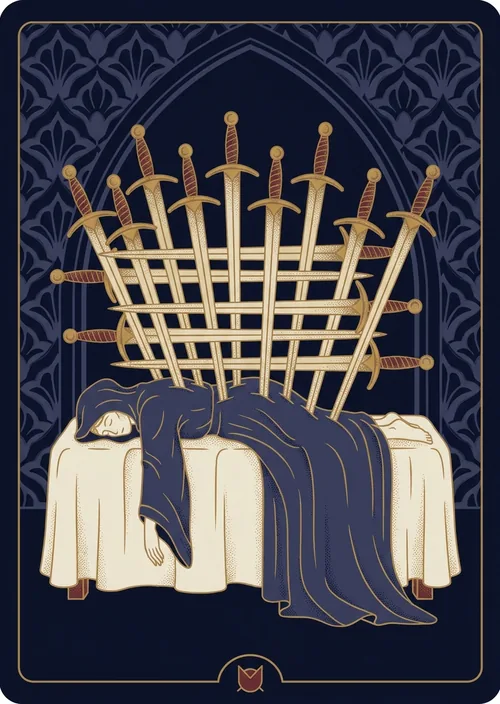
A figure lies face down at the water's edge under a red cloak, with ten swords driven into the back from neck to thigh. The sky above is black. On the far horizon a band of gold is already showing, and the water beyond the body is flat and untroubled.
The excess is deliberate. One blade would have done, and the tradition reads the surplus as the mark of something overstated, which is part of why the card is often taken as less final in practice than it looks. The gold at the horizon is doing the real work, since it places the picture at the point where the night has already turned. Readers also note the right hand, which is held in a blessing gesture rather than a clenched one.
Upright and reversed
Upright, the reading is a definitive ending, painful and complete. Ending, betrayal and rock bottom are the words attached to it. Betrayal is the one to handle carefully, since the card does not name an agent and many readers take the wound as self inflicted or circumstantial as readily as they take it as done to you. What the card does insist on is completeness. Nothing here is partly over.
Reversed, the split is real and the two readings point in opposite directions. In one the recovery is beginning, and survival is the operative word, because the figure in the picture is at the bottom rather than beyond it. In the other the ending refuses to arrive, and the situation drags on past the point where it should have finished, which readers often find harder than the upright card. Whether the surrounding cards show movement or repetition is usually what decides.
Tens, and the suit of air
The tens complete a suit and take its material as far as it goes. In cups that produces contentment, in pentacles inheritance and settled wealth, in wands a load carried past what one person should carry. Completion is the constant, and the element decides whether the completed thing is pleasant.
Swords carry air, read as thought, speech, conflict and the framing of a problem. Air taken to its limit is where the tradition puts the most difficult picture in the numbered minors, because a mind at full extension produces exhaustion rather than abundance. This is why the ten in this suit looks the way it does. The data used here gives air and no astrological ruler, which is standard for the pips, so number and suit carry the reading.
The question it puts
The question is whether what has ended is actually finished, or whether you are still supplying it with something. Endings that keep needing to be re-enacted are usually being fed, and the card is blunt enough to make that worth checking honestly rather than defensively.
This site treats a reading as a prompt for thinking, not as a forecast. Drawing this card is not a warning that something bad is coming and it is not a reassurance that things can only improve. It describes a low point with the light already changing behind it, and asks what you would do differently if you accepted that the thing was over.
Questions people ask about this
What does the Ten of Swords mean upright?
A definitive ending, painful and complete. Ending, betrayal and rock bottom are the associated words. The card does not name who caused it, so readers take the wound as inflicted or self inflicted depending on context.
What does the Ten of Swords mean reversed?
Either the recovery beginning, with survival as the emphasis, or the ending refusing to arrive and dragging on. These are opposite readings and the surrounding cards decide which applies.
Why are there ten swords when one would be enough?
The excess is read as overstatement. Many readers treat that as a signal that the situation is being experienced as more final than it is, which is part of why the card is less catastrophic in practice.
What is the gold light on the horizon?
The night in the picture has already turned, and the band of light is the detail most readers use to place the card at the bottom of something rather than past its end. It is not a promise of anything.
Is the Ten of Swords a bad card to draw?
This site does not read cards as good or bad luck. It is a difficult picture and the tradition attaches a hard meaning to it, but what it describes is a position rather than an event coming towards you.
What element does the Ten of Swords belong to?
Air, which covers thought, speech and conflict. There is no sign or planet attached in the data used here. The reading comes from the number ten completing a suit and from the suit itself.